





















We have long regarded gold as an essential asset class and recognize the benefits of including it in our dynamic, diversified core portfolios. Unlike stocks and bonds, gold is a real asset rather than a financial asset, and its distinct return drivers can provide meaningful diversification across a wide range of economic and market environments.
Our investment philosophy rests on the premise that markets are cyclical and that asset classes perform differently across each phase of the market cycle. Accordingly, we believe investors should look beyond traditional equity and fixed income allocations and incorporate real assets including gold and commodities when constructing portfolios intended to navigate full market cycles.
A valuable reason to hold gold is that it has historically served as a portfolio shock absorber, cushioning portfolios during periods of market stress, geopolitical uncertainty, and diminished confidence in traditional financial assets. At times, gold extends beyond its defensive role and contributes meaningfully to portfolio returns. From August 31, 2023 through August 31, 2026, gold gained 31.8%, compared with 21% for the S&P 500 Total Return Index (annualized), while over the past 25 years gold has delivered an annualized return of 11.8% versus 10.0% for the S&P 500 Total Return Index.
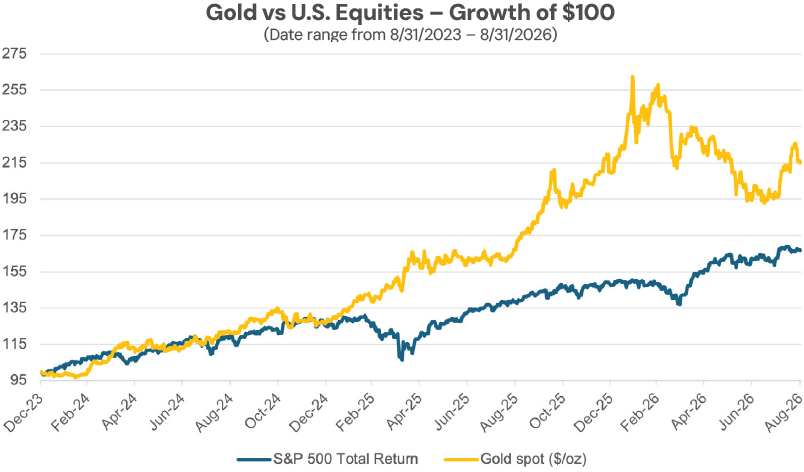
For these reasons, 3EDGE views gold not only as a tactical position, but as an important strategic component of our multi-asset investment process. By maintaining exposure to a broader opportunity set that includes real assets such as gold, we seek to improve diversification, manage downside risk, and generate attractive risk-adjusted returns over full market cycles.
Looking ahead, there are a number of potential factors that could influence the price of gold either positively or negatively.
Potential Headwinds
- The Federal Reserve’s recent increase in short-term interest rates may mark the beginning of a more restrictive policy environment. Historically, higher interest rates have pressured gold prices by raising the opportunity cost of holding a non-income-producing asset.
- A sustained rise in real (inflation-adjusted) interest rates could reduce the relative attractiveness of gold, which generates no income and therefore competes with real yield-bearing investments.
- Continued strength in the U.S. dollar could also weigh on gold prices, as the two assets have often exhibited an inverse relationship.
Potential Tailwinds
- Central banks worldwide continue to reassess reserve policies amid rising geopolitical tensions and growing concerns regarding sanctions risk. This trend may support ongoing demand for gold as a reserve asset.
- With U.S. national debt now exceeding $40 trillion, policymakers face increasing difficulty balancing economic growth, inflation management, and debt-servicing costs. History suggests that periods of elevated debt can shape monetary and fiscal policy in ways that may support real assets, including gold.
- Efforts to hold interest rates below the rate of inflation, including policies known as financial repression and fiscal dominance, could increase the attractiveness of real assets as investors seek to preserve purchasing power.
Investment Implications
Our primary objective is to construct portfolios that can adapt to a wide range of potential outcomes. Gold is one of several tools we employ in pursuit of greater diversification and portfolio resilience while also seeking to be additive to returns. As with any investments in the global capital markets, gold will inevitably experience periods of both strong and weak performance. However, we believe its distinct characteristics continue to support its role within our dynamic, globally diversified investment solutions.
In summation, in the current uncertain market environment we believe our gold allocations across our core strategies are appropriate. Meanwhile, we will continue to evaluate gold alongside the broader opportunity set of major asset class groups within our investment universe.