





















2026 has demonstrated one clear thing — valuations still matter.
As a fundamental manager, we’re often asked, “Yea, but is this the new normal?” when markets become detached from historic fundamental averages.
We’ve gotten that question quite a bit over the past couple of years with tech valuations. And the answer is generally always the same – we’ve seen no measurable data that suggests we should expect higher relative valuations as the new baseline.
Fast forward to February 2026.
It has been advantageous to be underweight Technology so far….
And our equity sleeve has handily outpaced the market in response, but that’s not the focus of this post. Rather, we’d like to focus on what the shakiness in equity markets might mean – and how we can work to prepare investors for whatever lies ahead in 2026.
When questioned about the market’s rich valuations, we address two things.
First – historically, there’s no evidence for a shift in the baseline upon which we measure relative valuations.
Second – elevated valuations do not mean that a market decline is imminent. However, it does mean that the market is going to be more sensitive to negative news than it would be otherwise (this is what we’re seeing today).
Reviewing valuations today, we can see that despite the shaky start, every sector remains above its historical price to earnings ratio (see table below).
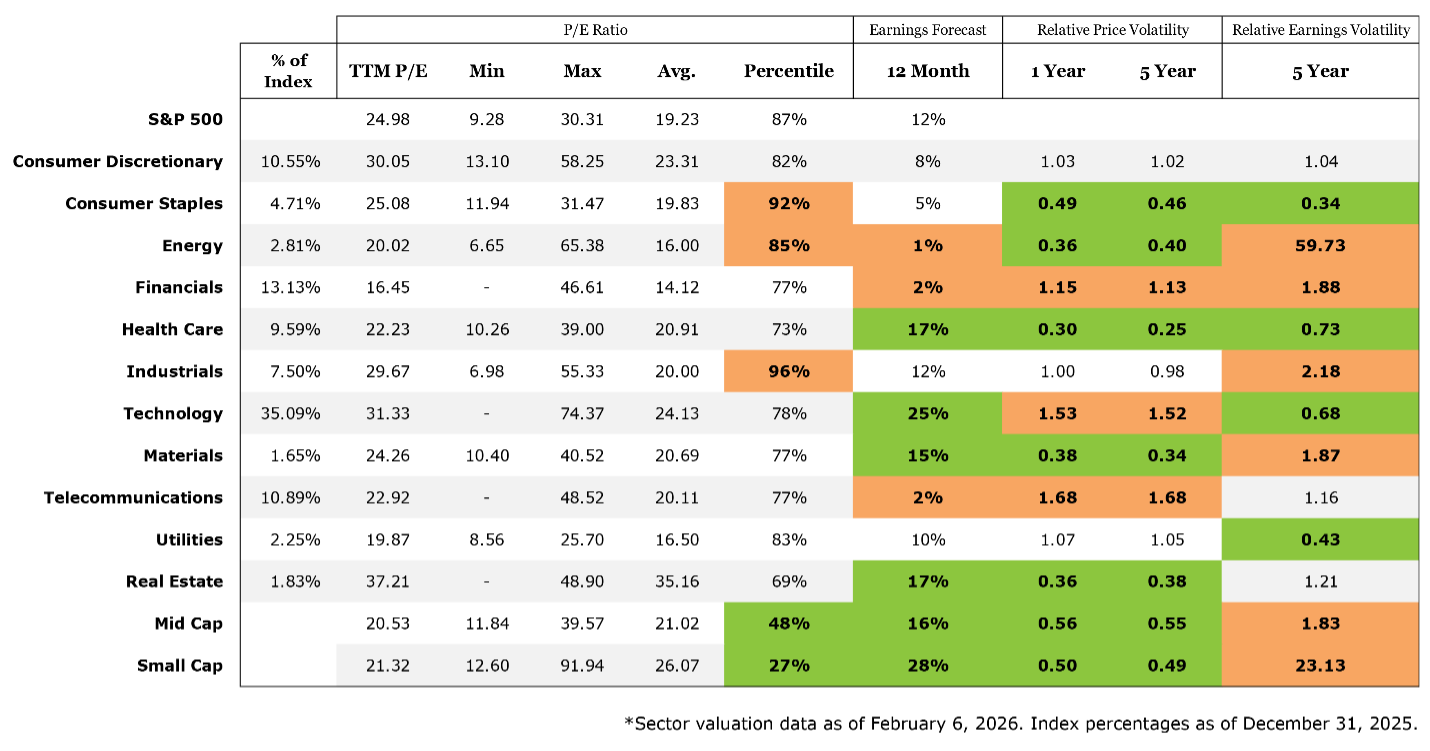
Technology remains relatively rich, with a valuation in the 78th percentile of its historical average. And despite a market-leading earnings projection, the sector also displays 1.5x the price volatility of the overall market (we’ve seen this play out in early 2026).
Health Care, on the other hand, is similarly overvalued (slightly lower ranking) and sports a strong, double-digit earnings growth (tied second among the sectors). What’s important to note though, is the price and earnings volatility. Health Care sports a market-leading 0.30 and 0.25 1- and 5-year relative price volatility — significantly lower than the market. Additionally, earnings are stable, with a 0.73 5-year relative volatility, compared to the market.
Which sector would you rather lean toward in today’s market?
We see a similar story with Materials and Consumer Staples. Materials carries a similar overvaluation ranking to Technology and a double-digit earnings forecast. And while earnings volatility is elevated, it carries the second lowest combined relative price volatility of the 11 market sectors. Consumer Staples, while richly valued, carries similarly low relative price volatility and a market leading relative earnings volatility. Compare these to Financials, which carries a similar overvaluation ranking, but just 2% projected earnings growth, market-leading price volatility, and nearly double the market’s earnings volatility…
Again, which sectors would you rather emphasize in today’s market?
And lastly, look at Small Cap and Mid Cap! While earnings volatility remains elevated, we’ve seen marked improvements in both segments’ P/E ranking, earnings forecast, and relative price volatility – another consideration as mega cap tech stocks fall out of favor.
The key takeaways are this – when markets are overvalued, we can expect higher volatility and a greater downside risk in the face of negative news. In markets like this, we’ve found that focusing on volatility, earnings, and balance sheet quality are critical to delivering a comfortable and confident investment experience.
A client that is comfortable and confident is one that is more likely to stay committed to their investment plan. And a client that remains committed to their investment plan is one that is more likely to reach their long-term goals.
Fundamental portfolios may not lead in highly concentrated markets – but that’s not the focus, and at the end of the day that’s not what’s important to most investors. In fact, we’ve found most investors value a strategy that tracks relatively well on the upside, but outperforms in periods of uncertainty (now being one of them) more than a strategy that outperforms when markets boom and disappoints when markets turn sour….
Questions tend to come in when the market gets shaky. That’s when instilling confidence becomes most important.
If you’re building multi-manager-diversified model portfolios, 2026 might be the year to implement a fundamental core around which you can pair tactical and downside diversifying strategies to tailor the experience to a variety of client profiles.
Click here to see how AAMA can help you do that.
Explore AAMA’s fundamental model portfolios here.