

















Are your client portfolios prepared for the next market selloff?

A sharp market selloff can come out of the blue.

It’s easy not to think about that when the market’s in an uptrend. However, the tariff-driven market plunge in April 2025 is just one recent reminder. In addition to the April selloff, four of the top 10 largest market drawdowns since 1927 have occurred after the year 2000. 

We believe major market declines happen frequently enough to be an expected part of your clients’ long-term investment horizon.
              

Assessing Portfolio Risk with Five Questions


The time to explore hidden risks in your client portfolios is before a market selloff and not during one. A quick risk audit is a good first step. You may find that slight portfolio shifts are all that are required to help improve portfolio risk management. 


Five key questions that an advisor should include in their risk audit:

  1. Is your sell discipline well defined, consistent and successful?
  2. When volatility spikes, how much of your portfolios can you shift into cash or other defensive positions before misaligning risk profiles?
  3. Are there underperforming investment managers that you should switch but haven’t?
  4. Have you done a correlation analysis among portfolio allocations and exposures?
  5. How concentrated are your portfolios – by sector, asset class or manager – and what happens if those areas face pressure?
Danger Signs


We believe it’s always important for your risk management to be as strong as possible. However, we think risk management takes on a greater urgency when you consider two key risks in today’s markets.

  1. Valuations near levels seen before the dot-com crash.
    Take the cyclically adjusted PE ratio (CAPE) of the S&P 500 Index, a widely followed metric. It represents the index’s current price divided by the 10-year moving average of its inflation-adjusted earnings. As we enter 2026, it stands at 40.58. The last time it rose above 40 was during the dot-com “bubble.
     
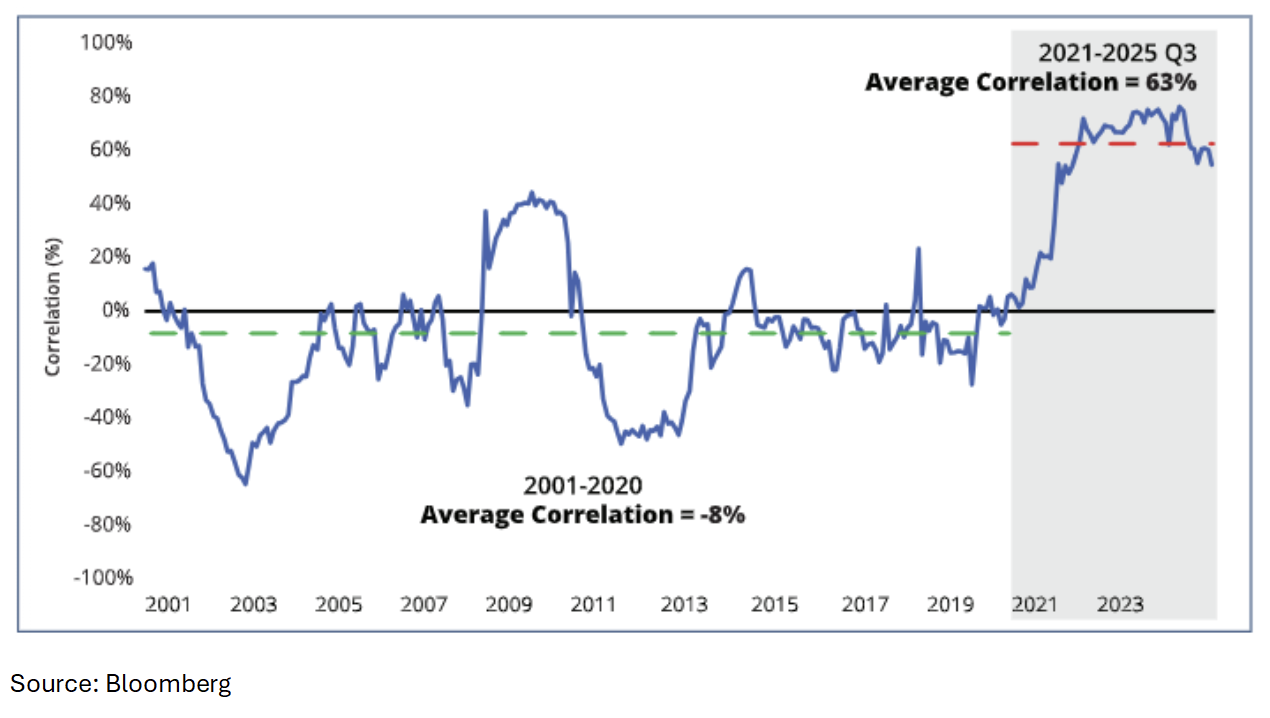
  2. Correlation between bonds and equities has risen 
    Historically, Treasury bonds and other investment-grade bonds have been seen as a ballast in a portfolio during times of equity market volatility.

    However, correlation between stocks and bonds can be unstable, and investment-grade bonds have become more correlated to equities. 

    Rolling 24-month correlation between the Bloomberg U.S. Aggregate Bond Index and the S&P 500 Index.
Rolling 24-month correlation between the Bloomberg U.S. Aggregate Bond Index and the S&P 500 Index.


Risk Management: Next Steps


As you audit portfolios for risks, see if their bond allocations have become more correlated with their equity exposures. If their correlations have increased at a time when the market’s valuation is historically high, consider revisiting your fixed income allocations and risk management approach.


Learn more about Ocean Park's model lineup available on Orion Portfolio Solutions.

Existing subscribers may access model fact sheets and more in the Advisor Portal. If you're new to Orion, we'd like to learn more, take you on a tour, and answer your questions.

THESE DISCLOSURES CONTAIN IMPORTANT INFORMATION AND SHOULD BE REVIEWED CAREFULLY.
IMPORTANT DISCLOSURES

There is no guarantee that any investment strategy will achieve its objectives, generate profits or avoid losses.
All investments involve risk, including the risk of loss of principal. More information related to the risks of investing
in Ocean Park Strategies/ Models/Programs can be found in Ocean Park’s Form ADV Part 2A.

The S&P 500 Index (Standard & Poor’s 500 Index) – A market-capitalization-weighted index of the 500 largest
U.S. publicly traded companies. The S&P is a float-weighted index, meaning company market capitalizations are
adjusted by the number of shares available for public trading.

Bloomberg US Aggregate Bond Index – A broad-based flagship benchmark that measures the investment grade,
US dollar-denominated, fixed-rate taxable bond market. The index includes Treasuries, government-related and
corporate securities, MBS (agency fixed-rate and hybrid ARM pass-throughs), ABS and CMBS (agency and nonagency).

Correlation – A statistic that measures the degree to which two securities move in relation to each other. Correlations are used in advanced portfolio management, computed as the correlation coefficient, which has a value that must fall between -1.0 and +1.0.

This information is for educational purposes and is not intended to provide, and should not be relied upon for,
accounting, legal, tax, insurance, or investment advice. This does not constitute an off er to provide any services, nor a solicitation to purchase securities. The contents are not intended to be advice tailored to any particular person or situation. We believe the information provided is accurate and reliable, but do not warrant it as to completeness or accuracy. This information may include opinions or forecasts, including investment strategies and economic and market conditions; however, there is no guarantee that such opinions or forecasts will prove to be correct, and they also may change without notice.

Advisory services are offered through Ocean Park Asset Management, LLC, a registered investment adviser (“RIA”)
regulated by the U.S. Securities and Exchange Commission (“SEC”). The advisory services are only off ered in jurisdictions where the RIA is appropriately registered. The use of the term “registered” does not imply any particular level of skill or training and does not imply any approval by the SEC. For information pertaining to the registration status of Ocean Park Asset Management, LLC, please call 1-844-727-1813 or refer to the Investment Adviser Public Disclosure website (www.adviserinfo.sec.gov).

This blog is sponsored by Ocean Park Asset Management. Orion Advisor Solutions, Inc. (“Orion”) or its affiliates and subsidiaries received compensation from Ocean Park Asset Management for the placement of this advertisement content. Ocean Park Asset Management and Orion are not affiliated companies, and the advertisement is not a recommendation or endorsement by Orion for any of the services referenced or provided.

This website may contain links to third-party websites. Any links to such third-party websites are provided solely as a convenience to you and not as an endorsement by Orion of the content on such third-party websites, or any affiliation or association with its operators. Orion is not responsible for the content of linked third-party websites, including, without limitation, any link contained in a linked website, or any changes or updates to a linked website, and do not make any representations regarding the information, services, products or accuracy of any material contained on such third-party websites.

This material does not constitute any representation as to the suitability or opportunities of any security, financial product or instrument. There is no guarantee that investment in any program or strategy discussed herein will be profitable or will not incur loss. This information is prepared for general information only. Individual client accounts may vary. It does not have regard to specific investment objectives, financial situation, and the particular needs of any specific person who may receive this report (information). Investors should seek financial advice regarding the appropriateness of investing in any security or investment strategy discussed and should understand that statements regarding future prospects may not be realized. Investors should note that security values may fluctuate, and that each security’s price or value may rise or fall. Accordingly, investors may receive back less than originally invested. Past performance is not a guide to future performance. Investing in any security involves certain non-diversifiable risks including, but not limited to, market risk, interest-rate risk, inflation risk, and event risk. These risks are in addition to any specific, or diversifiable, risk associated with particular investment styles or strategies.

Wealth management services provided by Orion Portfolio Solutions, LLC (“OPS”), a registered investment advisor. Orion OCIO services provided by TownSquare Capital, LLC (“TSC”), a registered investment advisor. OPS and TSC are affiliates and wholly owned subsidiaries of Orion Advisor Solutions, Inc.

Information presented herein with respect to any third-party service provider has been provided by those third-party service providers and has been reproduced here with their permission. Such information does not necessarily reflect the views and opinions of Orion Advisor Solutions, Inc. (“Orion”) or its affiliated companies. Orion does not endorse any particular third-party product or service. Our clients should undertake their own assessments to determine whether these parties meet their business and due diligence requirements. Ocean Park Asset Management and Orion Portfolio Solutions, LLC (“OPS”) are not affiliated companies, and the blog is not a recommendation or endorsement by OPS for any of the services referenced or provided. While some OPS solutions may contain one or more of the specific strategies mentioned, OPS is not making any comment as to the suitability of these, or any investment product for use in any portfolio.