





















Key takeaways:
- A dramatic rise in bond yields this year has spurred debate about the causality, with some pointing to large fiscal deficits, heavy corporate debt issuance and the increasing supply of bonds as the culprits. However, these factors were known before yields began to rise.
- We believe the primary driver of the bond market selloff is actually a more obvious one: The inflationary pressure emanating from a spike in oil prices.
- The stability of inflation expectations embedded in the bond market has caused some to doubt that the cost of oil is the main driver. However, the market’s expected response from the Federal Reserve to combat the impact of higher oil prices is likely creating that stability.
- If and when oil prices fall and stay down, the direction of rates will be the ultimate test of Occam’s razor.
William of Ockham died almost 700 years before anyone traded a Treasury bond, but the principle associated with his name still has value in understanding market behavior. When several explanations fit the facts, start with the one that requires the fewest assumptions.
That is a useful framework for thinking about this year’s rise in interest rates. Federal deficits are large, Treasury issuance is heavy and the AI infrastructure buildout is pulling extraordinary amounts of capital into corporate debt markets. Those forces are clearly part of the story. But if the question is what changed the direction of rates, the cleanest answer is the energy supply shock that followed the start of the Iran war. The timing is difficult to ignore.
Fuel for yields
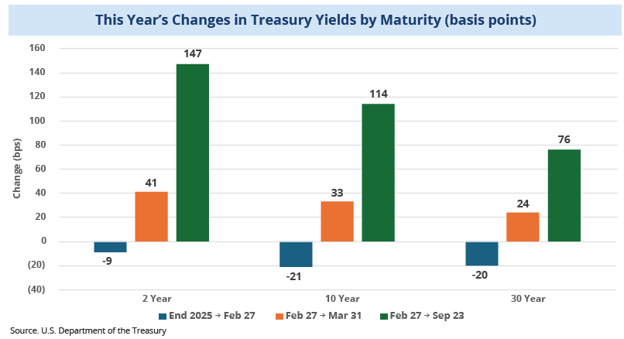
On February 27, the last trading day before the conflict began, the 2-year Treasury yielded 3.38%, the 10-year 3.97% and the 30-year 4.64%. Yields had generally been drifting lower through February. When markets reopened after the war began, the curve turned higher. By March 31, those yields had climbed to 3.79%, 4.30% and 4.88%, increases of 41, 33 and 24 basis points, respectively. The move continued over the following months and generally ebbed and flowed with oil prices along the way. The fiscal deficit, Treasury financing needs and the AI capital-spending boom were all well known before February 28. The war and the resulting threat to global energy supply were not.
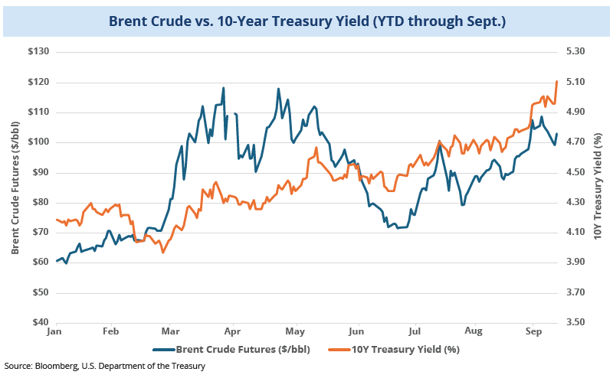
Oil affects the bond market because it changes the inflation problem. Higher crude prices feed directly into fuel costs and then indirectly into transportation, manufacturing, agriculture and a long list of goods and services.
This has not been an exclusively American selloff. Government yields have risen across Europe, the United Kingdom, Canada and Japan, even though those countries have very different fiscal positions and debt markets. Fiscal pressures can still amplify the move and may help explain why bond markets have absorbed the shock so poorly. The global nature of the selloff, however, makes domestic fiscal concerns a less convincing explanation for why yields changed direction when they did.
The limits of the Fed
Monetary policy can restrain demand, but it cannot produce oil or remove a shipping bottleneck. That makes higher rates a particularly blunt response to this kind of shock. As Mohamed El-Erian put it in his September 21 Financial Times column: “Crucially, the most effective remedies for today’s inflationary pressures do not lie with central banks. Instead, they lie with other policymakers. What’s needed on the supply side is to reduce the sensitivity of economies to multiplying choke points like the Strait of Hormuz, either through the direct lifting of maritime disruptions or a larger number of ways around them.”
Yet, the Fed cannot simply look past the problem. With inflation already above target, a sustained rise in energy prices increases the risk that businesses raise prices more broadly, workers seek compensation for higher living costs and inflation expectations become less stable. The market therefore has to price both the immediate inflation effect and the possibility of a tougher policy response designed to keep those pressures from spreading.
After the Fed raised rates for the first time since July 2023, Fed chair Kevin Warsh said at his post-meeting press conference, “We cannot affect any individual price, whether it be oil prices, whether it be food stuffs at the grocery store. But what we can do, and will do, is ensure that any change in relative prices doesn’t broaden out, don’t have second- and third-order effects in the economy. That’s what we’re tasked to do, and that’s what we will do.”
That mindset helps explain why the move has been broad across the curve. The 2- and 5-year sectors, which are heavily influenced by expectations for the federal funds rate over the next several years, have risen at least as meaningfully as the long end. If this were mainly a sudden loss of confidence in the government’s long-run fiscal position, one would expect the 30-year bond to lead the selloff.
Blunting Occam’s razor?
The strongest counterargument to the oil thesis emerges when looking at inflation expectations based on breakevens.
(Refresher: Breakevens are the difference in yield between Treasuries and Treasury Inflation Protected Securities of the same maturities. TIPS reflect “real” yields versus the nominal yields of standard Treasuries.)
Despite a rise in oil prices, inflation expectations based on breakevens have not risen enough to explain the increase in nominal yields.
The 10-year nominal yield rose about 104 basis points while the corresponding TIPS real yield rose about 96 basis points, leaving only a modest increase in inflation compensation. The same pattern held at 30 years. Stability of inflation expectations is seen on the short end as well, so breakevens aren’t answering why nominal yields have surged.
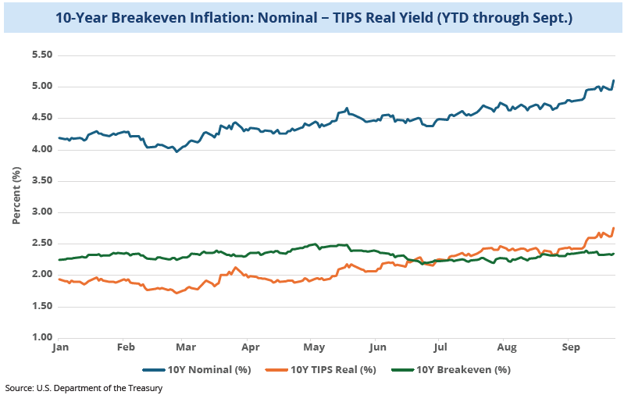
A rise in real yields can still be part of the market’s response to an inflation shock because investors also have to consider what the central bank is likely to do next. If an energy shock forces the Fed to keep nominal policy rates higher for longer while longer-run inflation expectations remain anchored, the expected real policy rate rises along with nominal policy rates.
In other words, the market can see more inflation risk and still believe the Fed will respond strongly enough to keep that risk from becoming permanent.
Inflation expectations based on breakevens can remain relatively stable for exactly that reason, while real yields rise to reflect a more restrictive expected policy path.
Ultimately, the stability of inflation expectations is a vote of confidence in the Fed; however, the Fed is responding to inflationary forces driven by oil prices. Thus, Occam’s razor remains in place: Oil prices are the primary driver in today’s rise in yields.
Oil prices vs structural drivers
The structural case still deserves weight, especially when thinking about where yields settle after the energy shock fades. In his September 22 memo, “Shall We Repeal the Laws of Economics – Part III,” Howard Marks focused on the amount of capital being demanded at the same time by Washington and the private sector. As Marks wrote, “The simplest rule of economics is that increased demand for something causes its price to rise. It’s entirely understandable, therefore, that this growing demand for capital should put upward pressure on the price of money: interest rates.”
The federal government must finance large deficits and refinance its enormous debt, while the AI buildout requires investment in data centers, semiconductors, power generation and transmission. That is a persuasive explanation for why interest rates may remain higher than they were in the decade after the financial crisis and why the bond market was vulnerable to additional pressure. It is less persuasive as an explanation for the precise timing of the turn and day to day fluctuations since then.
The key distinction is between backdrop and catalyst. Fiscal deficits, Treasury supply and private capital demand form the backdrop. The Iran war supplied the catalyst by changing the inflation outlook and, more importantly, the expected reaction of central banks. Recent market behavior continues to fit that interpretation. When crude prices have eased on better prospects for energy supply, Treasury yields have tended to move lower as well. The relationship will not hold tick for tick, nor should it. Economic data, Fed communication, issuance and risk sentiment can all push rates in either direction. But oil has become a much more important input into the rate market than it was before February 28.
Conclusion
Time will tell whether the oil-price-driven thesis holds. If oil prices fall materially and stay down while real yields and the Treasury curve remain near current levels, the structural explanations deserve more weight. That would suggest that deficits or stronger investment demand are doing more of the work than oil prices. If lower oil is accompanied by a softer expected Fed path and falling Treasury yields, the case that the recent move was primarily energy-driven becomes stronger.
For now, Occam’s razor points to a simpler reading of events. The major concerns surrounding debt and capital demand were already in the market. The sharp change in energy supply risk was not.