
















Key takeaways:

  • Kevin Warsh, who is expected to replace Jerome Powell as the new Federal Reserve chair, has vowed independence from the White House.
  • Under Warsh’s preferred framework, inflation today looks closer to target, giving him cover for rate cuts. Warsh prefers ranges to point estimates, a shift that would widen the goalposts on what constitutes “on target.”
  • While his preferred inflation readings may be currently lower than the Fed’s historically preferred reading, they’ve run higher in the past. If that pattern repeats, Warsh would be stuck defending a framework that works against his dovish impulses.
  • There is a larger force that may be at work in the Warsh era: AI may be replacing the Fed as the center of gravity for the markets.

Jerome Powell’s final act as Federal Reserve chair played out with a fitting degree of drama: An 8-4 vote at the April FOMC meeting to hold rates steady, four dissents for the first time since 1992 and a departing chairman still waiting for a DOJ investigation to fully close before stepping aside. It was a complicated ending to a tenure that will be debated for years. But the more important question for investors is what lies ahead as a new leader takes the helm.

Kevin Warsh, who cleared the Senate Banking Committee on a party-line vote, is now expected to receive full confirmation before Powell’s term as chair officially expires. He brings five years on the Board of Governors spanning the financial crisis and a well-documented set of views on how the Fed lost its way. Unlike many nominees who arrive with lower profiles, Warsh has been publicly writing and speaking about monetary policy for over a decade. That familiarity is both reassuring and unsettling because his vision of the Fed looks meaningfully different from the one Powell ran.


Don’t assume a dovish pivot

The market’s initial concern was straightforward: Is Warsh just a vessel for the White House’s demands for rate cuts? His Senate testimony pushed back on that notion. He told the committee that the president never asked him to commit to rate cuts and that he would not have agreed to such a condition.

But the rate picture is more nuanced than a simple dove-or-hawk framing. Warsh believes the Fed’s inflation models are broken and that the institution is still dealing with the consequences of the 2021-2022 policy errors. However, the ultimate decision on the federal funds rate policy is not his alone.

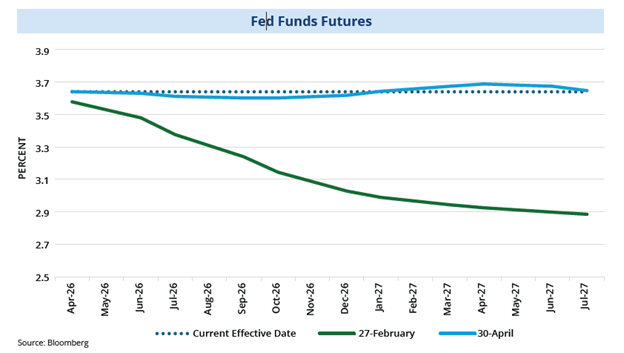
The April FOMC’s four dissents were a message that others may not share his perspective (three of the dissents objected to the FOMC statement’s residual easing bias). Energy prices remain elevated from the Iran conflict, consumer spending continues to hold up and the fed funds futures market is signaling no rate cuts on the horizon. Warsh may want lower rates eventually, but the committee he inherits is not inclined to follow their new leader, at least for now.
 

Fed Funds Futures


Moving the goalposts

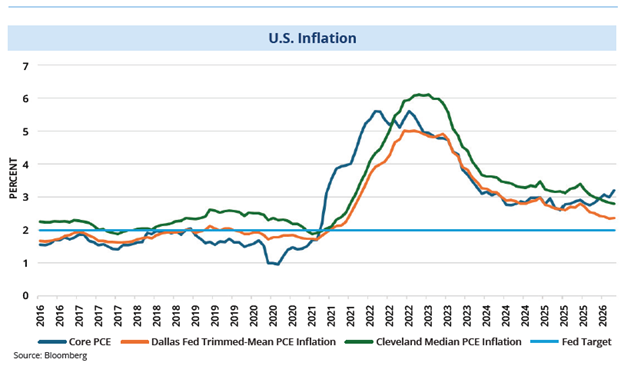
Perhaps the most underappreciated element of Warsh’s testimony was his stated preference for how the Fed measures inflation. The current benchmark is the Personal Consumption Expenditures Price Index, Excluding Food and Energy (the core PCE). Warsh considers this measure to be potentially misleading. He told the Senate Banking Committee that he prefers measures that remove the most extreme price movements on both ends of the distribution. Both the Dallas Fed and the Cleveland Fed publish versions of this gauge. The Dallas Fed’s trimmed mean sits around 2.4% and Cleveland’s measure at 2.8%, compared to the current core PCE of 3.2%.
 

US inflation


Under Warsh’s preferred framework, inflation today looks closer to target, giving him cover to argue for rate cuts without appearing to do the White House’s bidding. He reinforced the point by questioning the false precision of a hard 2% target during his testimony, noting that the Fed cannot realistically distinguish between inflation at 1.7% and 2.3%.

quote

The adage ‘be careful what you wish for’ may be appropriate for this line of thinking. Bank of America has pointed out that trimmed measures have not always read lower than the core PCE. In 2019 and 2020, trimmed readings ran higher, which would have argued for tighter policy. If that pattern repeats, Warsh could be stuck defending a framework that works against his dovish impulse. Still, in the current environment of tariff-related price spikes and energy shocks, trimmed measures arguably capture the underlying trend more faithfully. Whether the shift represents analytical improvement or convenient reframing will matter more once the geopolitical noise subsides.


Where the real fight lives

If rate policy is the headline and inflation measurement is the subtext, the balance sheet is the story. This is where Warsh’s views are most distinct from Powell’s.

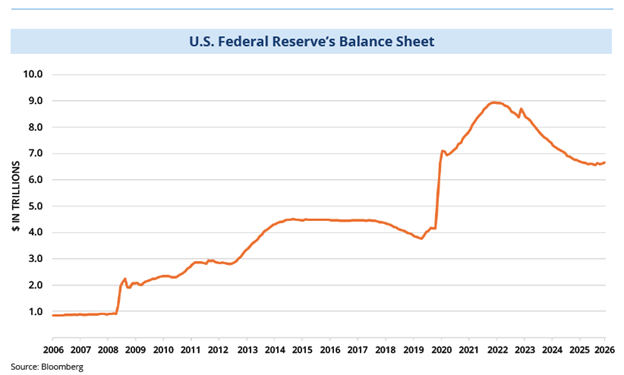
The Fed’s balance sheet stood at roughly $900 billion before the financial crisis, peaked near $9 trillion in early 2022, and currently sits around $6.7 trillion. Warsh has called this level of central bank involvement in long-term debt markets a form of fiscal policy in disguise. His prescription is reduction, but he has been deliberate about the pacing, acknowledging that the balance sheet took decades to build and that unwinding it requires time, patience and consensus across the FOMC.
 

US Federal Reserve Balance Sheet


Warsh has used his position on the balance sheet size to deflect the dove label. A smaller balance sheet means less liquidity, which reduces inflationary pressure. Less inflationary pressure, measured through his preferred trimmed gauges, means the Fed can afford a lower policy rate. It’s a coherent framework that lets him be simultaneously hawkish on institutional discipline and dovish on borrowing costs.

Whether the bond market buys the logic is another matter.

The risks of getting the pace wrong are not insignificant. In September 2019, balance sheet runoff contributed to a seizure in overnight funding markets, forcing the Fed into emergency repo operations. Any reduction program that drains reserves too aggressively risks a repeat, and the current political environment around the Fed would make such a stumble far more damaging.


What investors should watch

The near-term read on Warsh is probably net neutral. He is not arriving with an opening to cut rates on day one, nor is he proposing anything dramatic enough to spook bond markets. But the medium-term picture is less clear.

If the Fed scales back forward guidance and the dot plot as Warsh has suggested, fixed income volatility may increase as traders lose the guardrails they have relied on. On the balance sheet, the gap between passive runoff and active sales is meaningful. The added supply of Treasuries and mortgage-backed securities will bias longer term rates higher, all else being equal. Assuming the new chair can build a consensus around lowering rates, a steeper yield curve should be expected.

Perhaps the most significant risk is that any perception that policy is being shaped by politics rather than the data could unsettle inflation expectations that currently remain anchored.

There is a larger point worth acknowledging. For the better part of two decades, the Fed was the undisputed center of gravity for financial markets. Every press conference, every dot plot, every shift in the FOMC statement’s language moved billions. That era may not be over, but it has been eclipsed by a new center of influence.

quote

The mega-cap names driving index returns are being valued on their AI positioning, not on whether the Fed cuts rates once or twice. Warsh himself seemed to recognize this during his testimony, citing AI-driven productivity gains as a potential structural disinflationary force. He is inheriting the most powerful economic policy institution in the world at a moment when that institution’s grip on market sentiment is arguably the weakest it has been since before the financial crisis.
 

Access Ocean Park's
Model Lineup on Orion

Expand your offering and unlock new opportunities with direct access to Ocean Park's model lineup, integrated seamlessly into Orion platforms.

Learn More

ABOUT THE AUTHOR

James St Aubin

James St. Aubin, CFA®, CAIA®, is Chief Investment Officer for Ocean Park Asset Management. He has oversight of all Investment Management department activities, in collaboration with Co-founders David Wright and Kenneth Sleeper. An experienced investment management executive, his career of more than 20 years includes leadership roles in asset allocation, manager research and portfolio construction. James earned a Bachelor of Science in Finance from DePaul University and is a CFA® and CAIA® Charterholder.


RISKS AND DISCLOSURES:

This blog is sponsored by Ocean Park Asset Management. Orion Advisor Solutions, Inc. (“Orion”) or its affiliates and subsidiaries received compensation from Ocean Park Asset Management for the placement of this advertisement content. Ocean Park Asset Management and Orion are not affiliated companies, and the advertisement is not a recommendation or endorsement by Orion for any of the services referenced or provided.

This website may contain links to third-party websites. Any links to such third-party websites are provided solely as a convenience to you and not as an endorsement by Orion of the content on such third-party websites, or any affiliation or association with its operators. Orion is not responsible for the content of linked third-party websites, including, without limitation, any link contained in a linked website, or any changes or updates to a linked website, and do not make any representations regarding the information, services, products or accuracy of any material contained on such third-party websites.

This material does not constitute any representation as to the suitability or opportunities of any security, financial product or instrument. There is no guarantee that investment in any program or strategy discussed herein will be profitable or will not incur loss. This information is prepared for general information only. Individual client accounts may vary. It does not have regard to specific investment objectives, financial situation, and the particular needs of any specific person who may receive this report (information). Investors should seek financial advice regarding the appropriateness of investing in any security or investment strategy discussed and should understand that statements regarding future prospects may not be realized. Investors should note that security values may fluctuate, and that each security’s price or value may rise or fall. Accordingly, investors may receive back less than originally invested. Past performance is not a guide to future performance. Investing in any security involves certain non-diversifiable risks including, but not limited to, market risk, interest-rate risk, inflation risk, and event risk. These risks are in addition to any specific, or diversifiable, risk associated with particular investment styles or strategies.

Wealth management services provided by Orion Portfolio Solutions, LLC (“OPS”), a registered investment advisor. Orion OCIO services provided by TownSquare Capital, LLC (“TSC”), a registered investment advisor. OPS and TSC are affiliates and wholly owned subsidiaries of Orion Advisor Solutions, Inc.
Information presented herein with respect to any third-party service provider has been provided by those third-party service providers and has been reproduced here with their permission. Such information does not necessarily reflect the views and opinions of Orion Advisor Solutions, Inc. (“Orion”) or its affiliated companies. Orion does not endorse any particular third-party product or service. Our clients should undertake their own assessments to determine whether these parties meet their business and due diligence requirements. Ocean Park Asset Management and Orion Portfolio Solutions, LLC (“OPS”) are not affiliated companies, and the blog is not a recommendation or endorsement by OPS for any of the services referenced or provided. While some OPS solutions may contain one or more of the specific strategies mentioned, OPS is not making any comment as to the suitability of these, or any investment product for use in any portfolio.
These materials may not be copied, altered, or redistributed without the prior written consent of Ocean Park Asset Management, LLC. This information is for educational purposes and is not intended to provide, and should not be relied upon for accounting, legal, tax, insurance, or investment advice. This does not constitute an offer to provide any services nor a solicitation to purchase securities. The contents are not intended to be advice tailored to any particular person or situation.

Unless otherwise noted or sourced within, the statements herein are the opinion of the author. The statements have been made based on publicly available information and proprietary research but remain the opinion of the author unless noted otherwise. We do not guarantee the accuracy or completeness of the information provided in this document. All statements and expressions herein are subject to change without notice. Any projections, market/ economic outlooks or estimates herein are forward-looking statements based upon certain assumptions and should not be construed to be indicative of the actual events that will occur. Other events that were not taken into account may occur and may significantly affect the statements made herein. Except where otherwise indicated, the information and statements provided herein are based on matters as they exist as of the date of preparation and not as of any future date, and we are under no obligation to correct, update or revise the information in this document or to otherwise provide any additional materials.

Ocean Park Asset Management, LLC is a registered investment advisers (“RIA”) regulated by the U.S. Securities and Exchange Commission (“SEC”). The use of the term “registered” does not imply any particular level of skill or training and does not imply any approval by the SEC. For information pertaining to the registration status of Ocean Park Asset Management, LLC, please call 1-844-727-1813 or refer to the Investment Adviser Public Disclosure website (www.adviserinfo.sec.gov).

©2026 Ocean Park Asset Management. All rights reserved.