

















For much of the last sixteen years, investors had little reason to think deeply about bonds.

Stocks consistently outperformed. Interest rates hovered near historic lows. Passive investing encouraged everyone to view fixed income as little more than portfolio ballast, useful, boring, and mostly an afterthought. Bonds still had a job, of course. Correlations were generally low, and there were moments, like the dot-com bust and the Global Financial Crisis, when bonds reminded everyone why they were invited to the party.

Then rates started rising in 2021.

Stock and bond correlations picked up right into the wreckage of 2022, the year bonds were supposed to steady the ship and instead helped drag it down. Since then, correlations have remained elevated, reaching levels not seen since the late 1990s. 
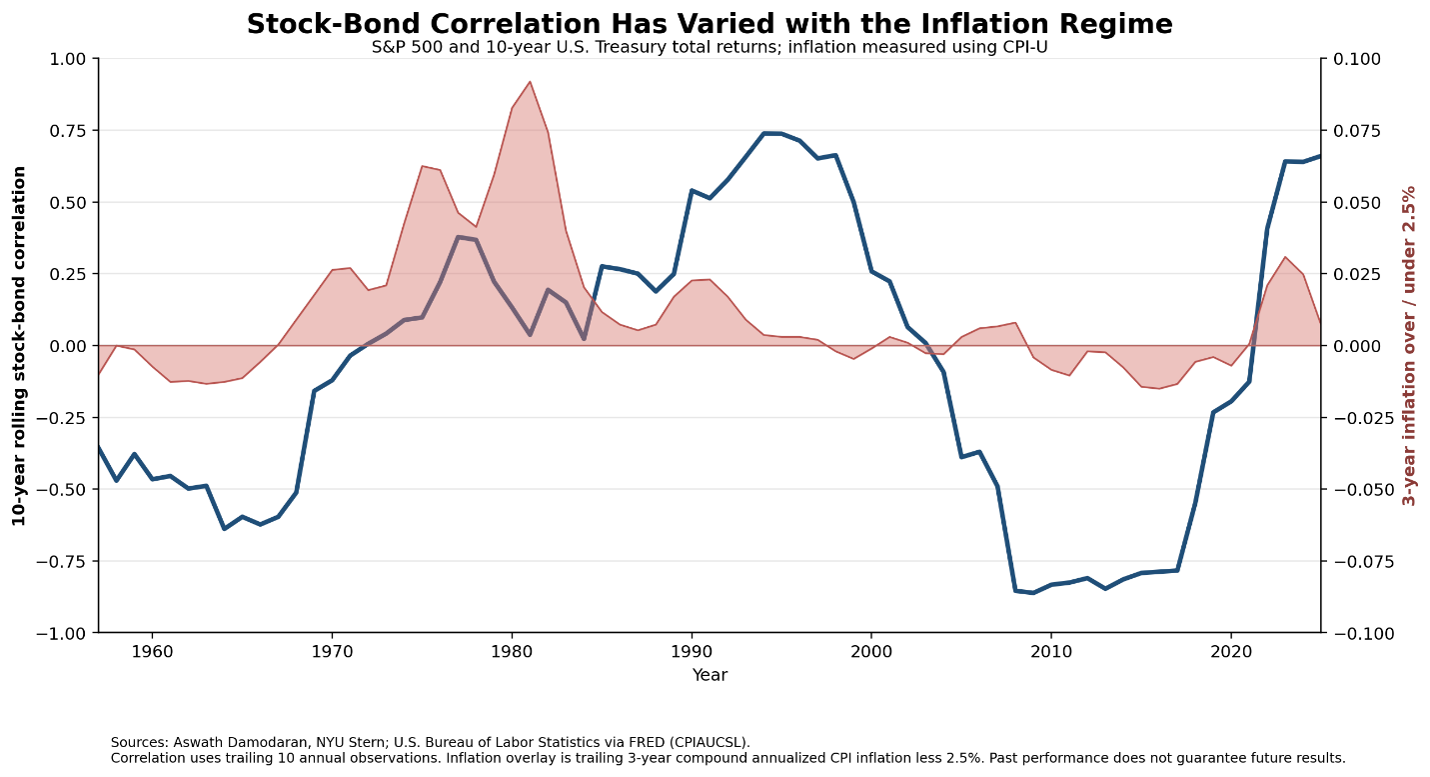
 

stock bond correlation with inflation


That has eroded trust in the traditional stock/bond diversification story.

It is easy to forget that stock and bond correlation has never been a law of nature. It has historically been inconsistent; we just got used to the uncorrelated version. As Phil Toews notes in The Behavioral Portfolio, bonds often add stability, but their effectiveness depends on variables like valuations, interest rates, inflation, and the fact that corporate stocks and corporate bonds ultimately rely on the same companies. In 2022, investors got a very clear reminder that bonds can sometimes increase portfolio losses rather than offset them. 

 

student
Orion Advisor Academy

Master the 351 ETF Exchange

Sign up today to earn FREE CE with Toews Asset Management's course explaining the 351 ETF Exchange for tax-efficient portfolio restructuring and tax deferral.

Around the same time, enthusiasm grew for anything that could provide the utility and confidence bonds once offered. Alternatives, private credit, and esoteric products with compelling stories started drawing more attention. Some of them may have a role. Some of them may also have mechanics only your friendly neighborhood CFA fully understands.

Maybe investors have been looking in the wrong place.

Bonds have always been boring. Now they are boring and unpopular? Poor bonds.

Flows have recovered somewhat, but a lot of that looks more like system-driven allocation like 401(k)s, model defaults, and institutional plumbing than a wave of renewed investor affection. The bigger point is that today’s fixed income market is fundamentally different from the one investors got used to during the zero-rate years.

Higher yields, wider dispersion across sectors, increased volatility, and persistent macro uncertainty have all reinvigorated the case for active bond management. In many respects, the case for tactical fixed income may be stronger today than at any point since the Global Financial Crisis.
The question is simple: if bond markets are no longer simple, why should bond exposure be?

Aggregate bond index products made fixed income cheap and easy. That matters, but easy exposure can come at a cost when rates, inflation, credit risk, and duration risk are all moving targets. A static bond index may give investors exposure, but it does not give them adaptability to potentially optimize for different markets.

A rules-based, adaptive bond strategy designed to participate in favorable fixed income environments while actively managing interest rate, inflation, and credit risk would seem preferable. The ability to shift between fixed income instruments as conditions change may provide opportunity or defense. The objective is to replace static buy-and-hold bond exposure with a dynamic risk management process that aims to reduce principal loss while seeking growth.

That is the part investors may be missing.

The goal is not to make bonds exciting. Please, no one needs that. The goal is to make the fixed income allocation more useful in the environment we actually have where rates can move, inflation matters, credit cycles are in flux, and correlations may not behave the way a back test from the 2010s made everyone feel.

Why wouldn’t an advisor want a bond manager that can move opportunistically and defensively as market conditions change?
 

Experience Orion and Toews Asset Management Together

Expand your offering and unlock new opportunities with direct access to Toews Asset Management's model lineup, integrated seamlessly into Orion’s platform.

About the Author

Eben Burr is the President of Toews where he helps oversee the culture and direction of the firm which specializes in creating strategies designed with the clients financial and emotional wellbeing in mind. Eben has worked in various capacities at Toews since 2009 and before that in real estate in New York City. Eben advocates bringing behavioral psychology, introspection, and empathy into portfolio construction, planning, and communication.  He has a BA in history, studied architecture in Paris, has a master’s degree from Pratt in New York and now lives in Manhattan with his wife, son, and lots of guitars.
 

Disclosures

This blog is sponsored by Toews Asset Management. Orion Advisor Solutions, Inc. (“Orion”) or its affiliates and subsidiaries received compensation from Toews Asset Management for the placement of this advertisement content. Toews Asset Management and Orion are not affiliated companies, and the advertisement is not a recommendation or endorsement by Orion for any of the services referenced or provided.

This website may contain links to third-party websites. Any links to such third-party websites are provided solely as a convenience to you and not as an endorsement by Orion of the content on such third-party websites, or any affiliation or association with its operators. Orion is not responsible for the content of linked third-party websites, including, without limitation, any link contained in a linked website, or any changes or updates to a linked website, and do not make any representations regarding the information, services, products or accuracy of any material contained on such third-party websites.

This material does not constitute any representation as to the suitability or opportunities of any security, financial product or instrument. There is no guarantee that investment in any program or strategy discussed herein will be profitable or will not incur loss. This information is prepared for general information only. Individual client accounts may vary. It does not have regard to specific investment objectives, financial situation, and the particular needs of any specific person who may receive this report (information). Investors should seek financial advice regarding the appropriateness of investing in any security or investment strategy discussed and should understand that statements regarding future prospects may not be realized. Investors should note that security values may fluctuate, and that each security’s price or value may rise or fall. Accordingly, investors may receive back less than originally invested. Past performance is not a guide to future performance. Investing in any security involves certain non-diversifiable risks including, but not limited to, market risk, interest-rate risk, inflation risk, and event risk. These risks are in addition to any specific, or diversifiable, risk associated with particular investment styles or strategies.

Wealth management services provided by Orion Portfolio Solutions, LLC (“OPS”), a registered investment advisor. Orion OCIO services provided by TownSquare Capital, LLC (“TSC”), a registered investment advisor. OPS and TSC are affiliates and wholly owned subsidiaries of Orion Advisor Solutions, Inc.

Information presented herein with respect to any third-party service provider has been provided by those third-party service providers and has been reproduced here with their permission. Such information does not necessarily reflect the views and opinions of Orion Advisor Solutions, Inc. (“Orion”) or its affiliated companies. Orion does not endorse any particular third-party product or service. Our clients should undertake their own assessments to determine whether these parties meet their business and due diligence requirements. Toews Asset Management and Orion Portfolio Solutions, LLC (“OPS”) are not affiliated companies, and the blog is not a recommendation or endorsement by OPS for any of the services referenced or provided. While some OPS solutions may contain one or more of the specific strategies mentioned, OPS is not making any comment as to the suitability of these, or any investment product for use in any portfolio.

Toews Asset Management is an SEC registered investment adviser with its principal place of business in the State of New Jersey.

This article may include forward-looking statements. All statements other than statements of historical fact are forward-looking statements (including words such as “believe,” “estimate,” “anticipate,” “may,” “will,” “should,” and “expect”). Although we believe that the expectations reflected in such forward-looking statements are reasonable, we can give no assurance that such expectations will prove to be correct. Various factors could cause actual results or performance to differ materially from those discussed in such forward-looking statements.

This article is intended to provide general information only and should not be construed as an offer of specifically tailored individualized advice, and no representation is being made as to whether the information provided herein would be beneficial for any or for a specific investor.

For additional information about Toews, including fees and services, send for our disclosure statement as set forth on Form ADV by contacting Toews at Toews Corporation, 1750 Zion Road, Suite 201, Northfield, NJ 08225-1844 or by visiting our website: www.toewscorp.com

Source notes:

https://www.morningstar.com/bonds/bonds-benchmarks-index-funds?

Bonds in crisis markets https://www.hartfordfunds.com/dam/en/docs/pub/whitepapers/HF0060.pdf

Stock bond correlation chart: https://inflationguy.blog/2026/06/04/a-new-era-of-positive-stock-bond-correlations-and-what-that-means/

Bond flow https://www.morningstar.com/funds/8-charts-us-fund-flows-2025-highest-net-inflows-since-2021 

Stock and bond correlation https://www.nationwide.com/financial-professionals/blog/markets-economy/articles/stocks-and-bonds-are-moving-together-now-what-for-portfolios