





















Some of the most consequential moments in an advisor-client relationship have very little to do with portfolio construction and much more to do with communication. While most investor clients don’t concern themselves with strategy selection and portfolio theory, they generally do want to understand why their portfolio looks the way it does, and advisors need a consistent, credible answer that holds up regardless of what markets are doing.
That's precisely the problem the Orion Investment Framework was designed to solve.
At its core, the Framework reflects a single conviction: individuals, not just endowments and foundations, can and should benefit from an institutional approach to investing that is backed by decades of investment management experience and behavioral finance principles. Orion built this framework to give advisors a structured, research-backed foundation that is rigorous enough to stand on its own, yet flexible enough for advisors to put their own fingerprint on implementation.
The Building Blocks: Grow, Earn, Diversify
The Framework categorizes investments across six asset classes, grouped into three intuitive, higher-level objective-based categories. Understanding the specific role that each individual objective plays in a portfolio is valuable, but the more instructive question is how they work together across market cycles.
As investors navigate shifting economic environments, it becomes clear that external forces can have real impacts on portfolios. Attempting to predict changes in the macro environment and reposition accordingly is difficult and, generally speaking, leads to unsatisfying outcomes. What the data does clearly show, however, is that different asset classes react, well, differently, to changing environments. An asset class that underperforms in one regime may provide meaningful ballast or outperformance in another. The Grow, Earn, Diversify framework is built around that belief.
Grow includes domestic and international equity, the engine of long-term capital appreciation. Equities have historically exhibited higher relative volatility than other core asset classes, but in return, investors hope to be rewarded with higher relative returns over time. This piece of the portfolio contributes to long-term capital growth.
Earn is anchored by core fixed income holdings, which are designed and implemented to generate reliable income and serve as a stabilizing force within the portfolio. Fixed income has historically provided its strongest risk-adjusted results during periods of softer growth. This kind of consistency helps clients stay on track when equity markets get choppy.
Diversify is where the Framework extends beyond traditional stock-and-bond portfolio construction. Global credit, alternatives, and real assets can collectively serve as volatility mitigators due to their lower correlations with traditional equities and fixed income, and we believe they deserve an allocation within most broadly diversified client portfolios. Real assets, for example, have historically held up well during inflationary periods, while alternatives can truly zig when other asset classes zag, regardless of the macro backdrop. No single diversifying asset class leads in every environment, which is precisely the point of holding a diversified mix in this bucket.
In this chart from the Orion Reference Guide, we analyzed the six asset classes across different regimes of GDP growth and levels of inflation. As you can see, average returns, sharpe ratios, and return leadership varies, somewhat drastically, across these four different economic regimes.
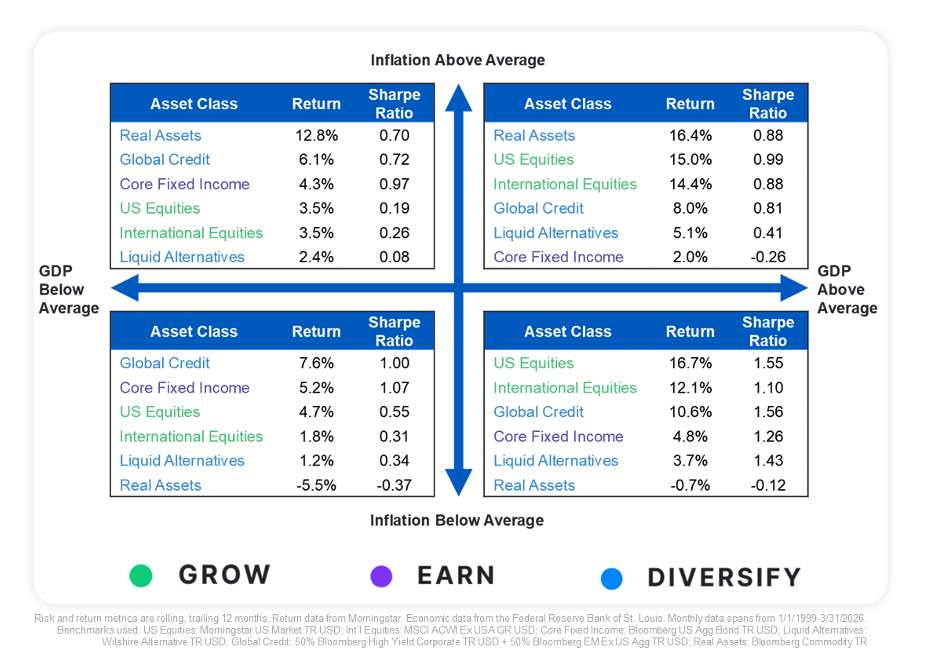
The practical takeaway here is straightforward. Investors who hold exposure across all three investment categories are positioned to participate in a variety of economic and market environments rather than concentrating risk in any single regime. That smoother journey over time increases the likelihood that clients will stay invested and stick to their long-term plan, which is ultimately where most of the value in financial planning is captured. Time in the market is more important than timing the market, as the cliché goes.
Why the Framework Matters for Your Practice
The benefits of operating within a defined investment framework extend well beyond creating efficiencies in portfolio construction, and this is a point we think is often underappreciated.
First off, there's the behavioral dimension. Mental accounting, or the tendency for investors to think about different portions of their portfolio or household assets in isolation, is typically viewed as a cognitive bias to overcome. The Framework turns this idea on its head and makes this bias an advantage, when reframed properly. When clients can see that a portion of their portfolio is explicitly designed to grow, another to earn, and another to diversify, they're better equipped to stay the course when bouts of volatility inevitably affect one or more parts of their portfolio. The investor who understands why they own alternatives during a down equity market is far less likely to make an emotionally charged, ill-timed decision.
Second, the framework provides a consistent baseline across client segments. High-net-worth clients and mass-affluent clients may, and likely should, hold different investment strategies, but under the Framework, both portfolios are constructed through the same lens. That consistency simplifies your messaging, strengthens your brand, and makes client conversations scalable.
Third, and perhaps most overlooked, a clearly articulated investment framework makes your practice more marketable. Advisors who can walk a prospective client through a coherent investment philosophy stand out in a crowded field. It's the difference between saying "we invest in a diversified mix of stocks and bonds" and articulating a systematic, goals-based approach grounded in institutional research.
A Framework Built for the Real World
One of the design principles we find most valuable in this framework is that it's high-level enough to allow flexibility but pointed enough to provide meaningful guidance for implementation. Advisors aren't handed a rigid model with no room to express their own views or customize for individual client circumstances. Instead, the Framework provides the scaffolding, a shared language for goals-based conversations and a consistent process for portfolio construction, while leaving room for the advisor's expertise and judgment.
If you're interested in learning more about the Orion Investment Framework or want to explore how to implement it across your practice, please reach out to Orion's Investment Strategy team. We're happy to walk through the details and help you think about how the Framework may help you and your clients.