

















Key Takeaways:
- While interest rates, geopolitical tensions, AI spending, and midterm elections are generating scary headlines, the biggest threats to long-term investment performance aren’t always the most visible.
- Emotional decision-making, tax drag, and concentrated portfolios can quietly erode returns, making investor discipline, tax-aware strategies, and diversification essential.
- Advisors can help clients look past the daily noise and focus on risks they can manage, keeping portfolios aligned with long-term goals.
Happy Halloween! This fall, millions of Americans will celebrate the spooky season by visiting a haunted house. They’re paying for the fog machines, the strobe lights, and the actors who jump out of nowhere. Most will receive a harmless, thrilling evening in return, but some will leave with a bruised elbow or a twisted ankle to show for it.
It probably won’t be the chainsaw guy’s fault. It’ll be the extra step they didn’t see in the dark, the doorframe they clipped as they rushed around the corner, or the friend who crashed into them because everyone was watching the zombie on their left. The scariest things we see aren’t always the biggest dangers.
It’s no different in investing, and this October, there’s no shortage of zombies and monsters in the headlines. These shouldn’t be ignored and can pose risks to portfolios, but fixating on macro themes we can’t control can cause us to miss the risks right in front of us, the ones we can actually take steps to avoid.
What’s Scaring Investors This October?
- Interest Rates: Rising inflation, deficit worries, and heavy corporate borrowing have pushed rates higher across the curve. Higher rates make borrowing more expensive for companies and consumers, and they give investors a more competitive alternative to stocks.
- Middle East Headlines & High Energy Prices: Rising inflation, deficit worries, and heavy corporate borrowing have pushed rates higher across the curve. Higher rates make borrowing more expensive for companies and consumers, and they give investors a more competitive alternative to stocks.
- AI Bubble Concerns & Debt-Funded Spending: As Big Tech’s AI capex begins to exceed their cash flow, companies are increasingly issuing debt to continue funding infrastructure buildout projects. Investors are still waiting to see whether the returns on these projects will justify the spending.
U.S. Midterm Elections: With control of Congress at stake on November 3, investors face uncertainty around taxes, tariffs, spending, and regulation. Markets dislike uncertainty and prefer stable, slow-moving policy. Election years also bring a steady stream of partisan headlines and ads that can make it feel like everything is on the line.
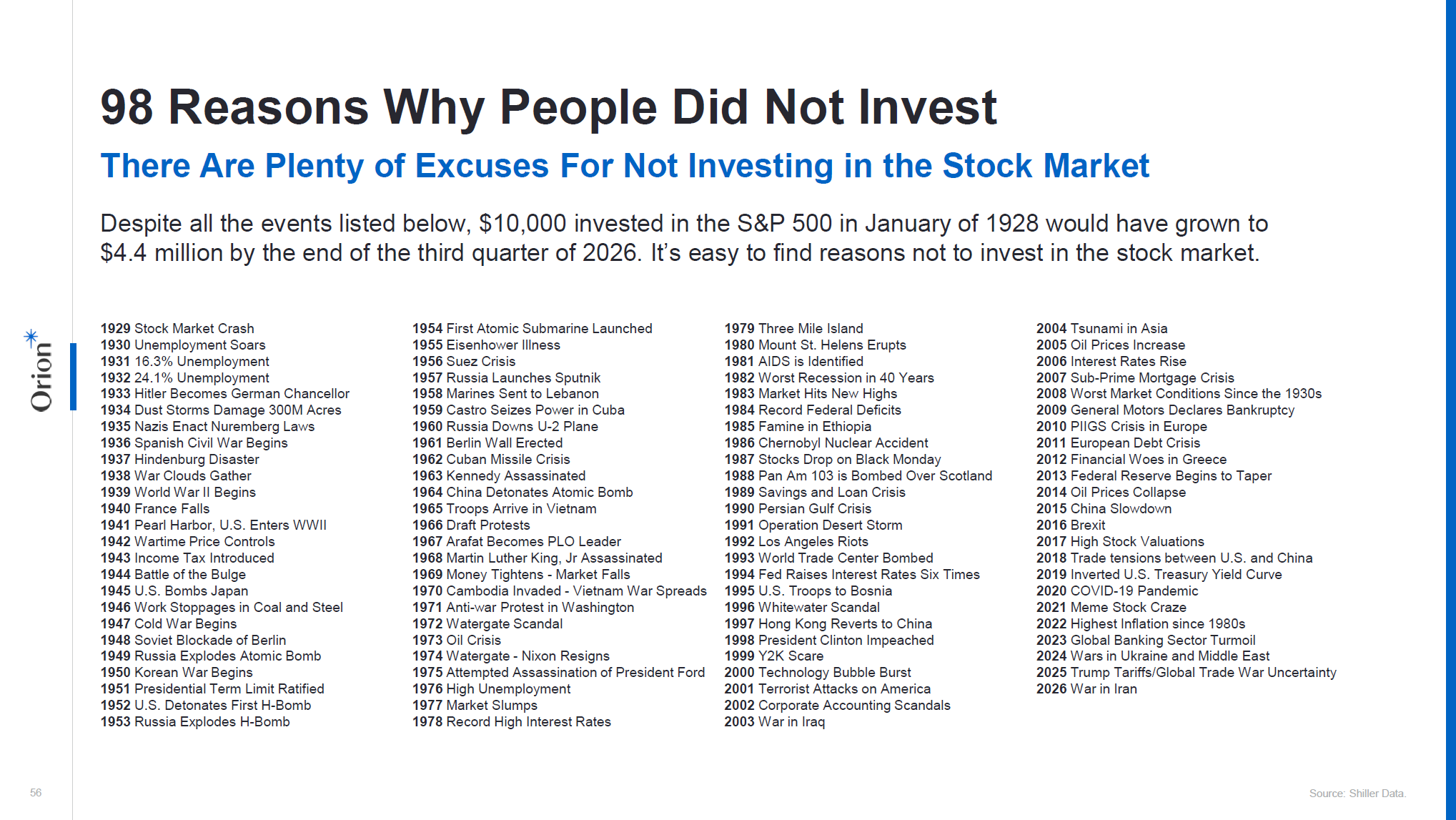
These concerns are valid, but despite the daily barrage of scary headlines, we’re entering the fifth year of a bull market driven by exceptional earnings growth, and expectations remain strong. I’m reminded of a favorite slide from Orion’s Quarterly Reference Guide: “98 Reasons Why People Did Not Invest.” There will always be uncertainty and volatility, but disciplined investors who look past the noise have historically been rewarded.
The Dangers that Quietly Threaten Long-Term Performance
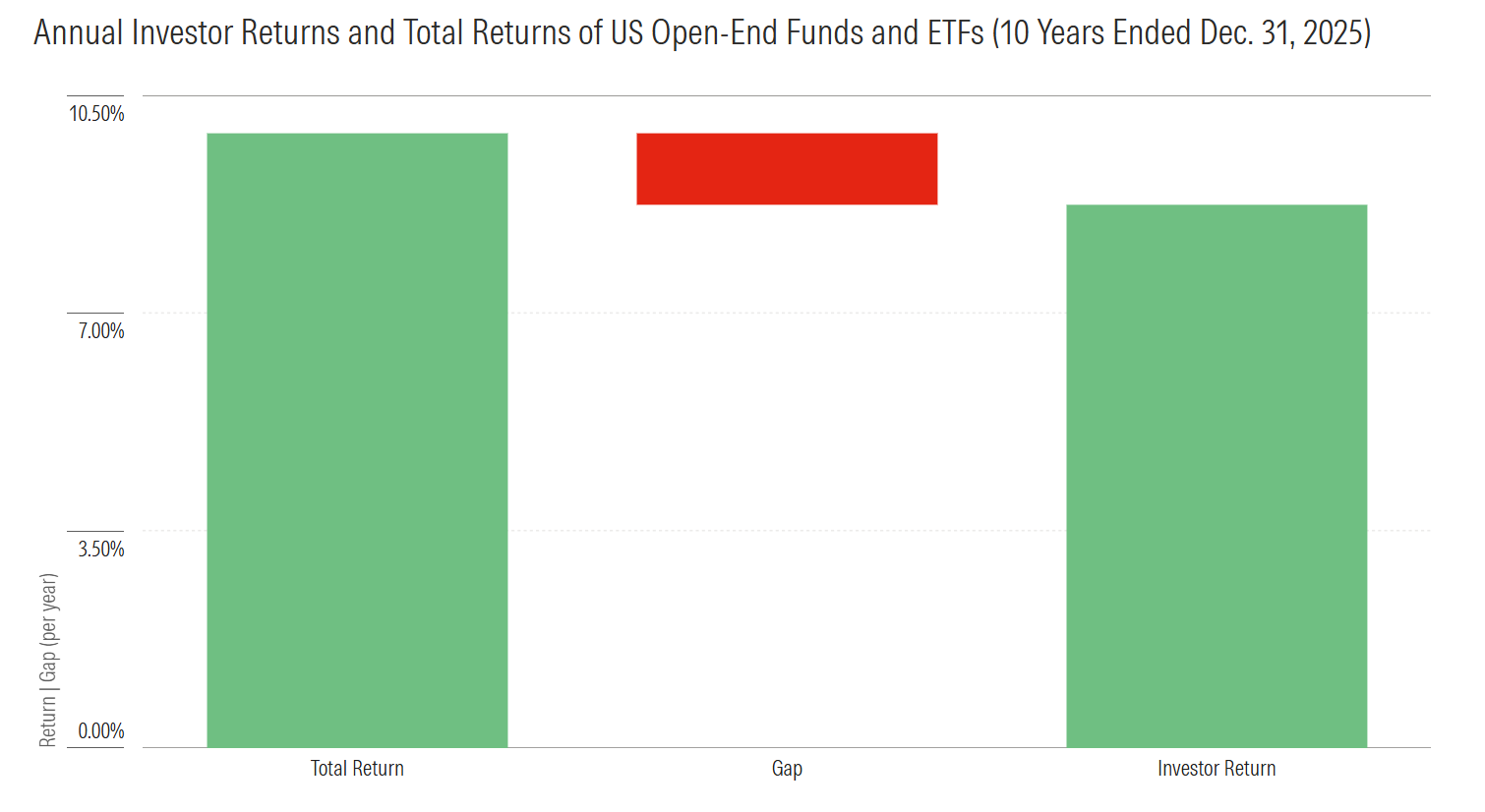
Investor Behavior: Morningstar’s annual Mind the Gap report seeks to quantify the “Behavior Gap,” or returns investors give up due to market timing relative to a buy-and-hold strategy. The 2026 report found that the average dollar invested in U.S. funds earned about 1.2% less per year than the funds themselves over the ten years ended December 2025, as return-chasing, fear, and emotional decision-making pulled investors away from their long-term plans. Compounded over a decade, that’s the difference between 157% cumulative returns and 130%.
The gap was widest in the most volatile funds, potentially reflecting a misunderstanding of risk tolerance. This is where advisors earn their fee – by having honest conversations about risk before making an initial investment, then by helping clients stick to their plan throughout market cycles. Vanguard estimates that behavioral coaching can add up to 2% per year1, and the biggest opportunities come in moments of market stress.
Source: Morningstar
- Taxes: Many clients smartly scrutinize expense ratios, making sure they’re getting what they’re paying for. But for taxable accounts, the bigger cost is often the tax bill. According to Morningstar, US large blend funds had a median tax cost ratio of 1.3% per year over the three years ended June 2026, assuming the highest tax rate. That’s often more than the fund’s expense ratio, but it never shows up as a line item.
Unlike macro trends and geopolitics, this is a risk advisors can help control through asset location, tax-loss harvesting, and tax-aware fund selection in non-qualified accounts. The aforementioned Vanguard study classifies tax-loss harvesting as the second most valuable function an advisor can provide, adding around 1.5% per year to net returns.
- Concentration: Every scary headline is scarier when your portfolio is concentrated in an affected sector. A debate over an AI bubble is background noise for a diversified portfolio, but an investor with half their wealth in a handful of chip stocks will lose sleep over it. Concentration lets one or two risks derail an entire plan.
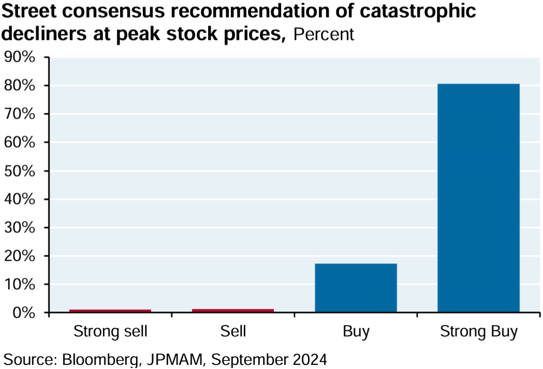
Single stocks can also be riskier than they look. J.P. Morgan found that from 1980 to 2014, 40% of Russell 3000 stocks suffered a “catastrophic loss,” or a 70% decline from peak with minimal recovery2. The warning signs were rarely obvious. In J.P. Morgan’s 2024 update, they noted that more than half of these stocks were profitable at their peak, most traded at reasonable valuations, and Wall Street consensus leaned heavily toward “strong buy.”
Source: JPMorgan
Diversification spreads those risks so one broken thesis doesn’t break a portfolio, while still letting investors participate in the themes driving returns, like semiconductors in this bull market, rather than missing them entirely.
There will always be new monsters jumping out at your clients, and that’s fine. After all, people who enter the haunted house should expect the unexpected. The real dangers come in the dark areas nobody’s watching: emotional decision-making, quiet tax drag, and too many eggs in one basket. Those are the risks advisors may be able to actually control. Enjoy the haunted houses this Halloween – just watch your step!