





















Our investment team is closely monitoring the developments in the Middle East with an eye towards understanding how the events might impact commodity prices, the stock market, and the world economy. We lament the loss of innocent life, pray for the safety of U.S. troops in harm’s way and mourn the U.S. military servicemembers who have lost their lives.
You should be hearing from us often over the coming days on the conflict with Iran. For now, we are not expecting any meaningful changes to our market and economic outlook or our current asset allocation. As it concerns this week’s note…
Weekly Notes from Tim
By Tim Holland, CFA, Chief Investment Officer
- From a markets point of view, 2026 looks a lot like 2025. Consider sources of volatility – trade (the Supreme Court ruling against the Trump Administration on the use of tariffs) and AI (though concerns of late have been less about an AI bubble and more about the technology disrupting if not outright disintermediating any number of technology and consumer services companies) and performance – international equities are easily outdistancing US equities (the MSCI EAFE Index and the MSCI EM Index are up 9% and 15%, respectively, year to date vs a gain of 1% for the S&P 500 as of February 27th).
- When Orion’s Asset Allocation Committee upgraded international equities in early 2025, it cited attractive valuation as one reason for its more constructive outlook on the asset class. Another reason, and key to the Committee’s decision, was the emergence of pro-growth fiscal policies in Europe, particularly Germany, the region’s largest economy, and an economy that had been in or just barely out of recession the past few years.
- More specifically, we thought the decision by the German government to invest up to $1 trillion in defense and infrastructure would prove economically stimulative (both on its own and by spurring private sector investment). And the economic situation in Germany is brightening, with manufacturing orders increasing a much better than expected 7.8% in December, the strongest increase in two years (see chart). There are multiple reasons to be bullish on ex-US markets; there is the forementioned attractive valuation, along with improving earnings growth, a weaker dollar and a general under allocation to the asset class by US investors. Being able to add improving growth in Europe’s largest – and the world’s third largest – economy to that list in 2026 would be a big deal.
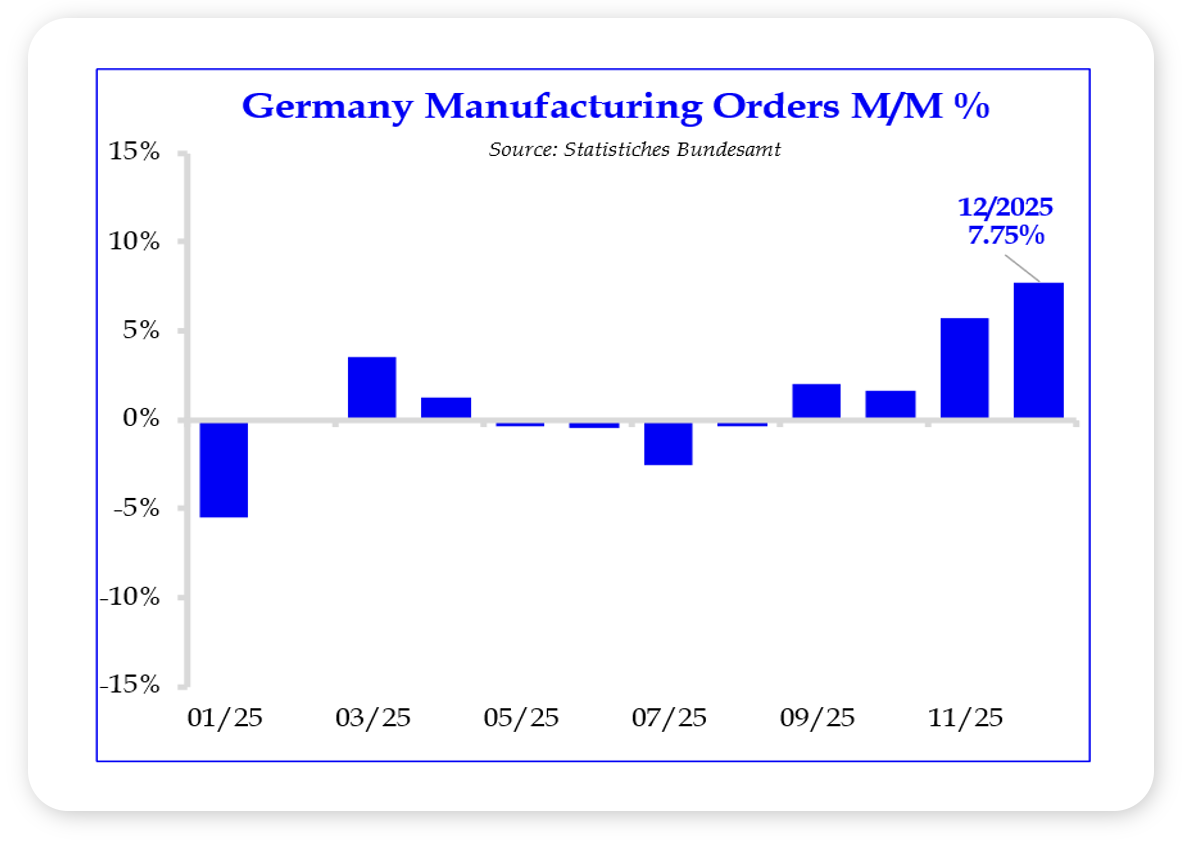
Source: Strategas, February 2026
Looking Back, Looking Ahead
By Ben Vaske, BFA, Manager, Investment Strategy
Last Week
Markets were mixed overall, though global equities finished positive. Emerging markets stood out with nearly 3% gains, while U.S. performance was weaker outside of mid-caps. Developed and emerging international markets continue to lead in 2026, with both now in double-digit return territory through just the first two months of the year. By contrast, the S&P 500 is up less than 1% YTD and the NASDAQ 100 remains negative.
NVIDIA reported another strong earnings beat, topping both revenue and earnings expectations. However, unlike some prior quarters, markets did not rally meaningfully. Investor skepticism toward software valuations and AI-related capital expenditures continues despite solid earnings growth and ongoing infrastructure investment.
Inflation concerns resurfaced. January PPI rose 0.5%, above expectations, adding uncertainty to the Fed’s rate outlook. At the same time, Treasury yields declined during the week, with the 10Y dipping below 4% for the first time since November, supporting fixed income returns. As 2022 rolls out of three-year return calculations, core bonds are now up more than 5% annualized over the past three years.
This Week
It is the first week of March, which brings both private and public labor market data. ADP employment and Nonfarm Payrolls will take center stage. Expectations are for 54,000 jobs added in February and an unchanged unemployment rate of 4.3%. Markets will weigh employment resilience against renewed inflation pressures to reassess the likelihood of Fed action later this year.
Geopolitics will remain in focus as tensions between the U.S., Israel, and Iran continue. Oil prices, energy stocks, and safe haven flows will be closely watched for signs of broader economic impact.
Earnings season continues with reports from Broadcom, CrowdStrike, Costco, and Target. With AI leadership being questioned and software under pressure, results from technology and consumer-facing companies could influence near-term market direction.
We hope you have a great week. If there’s anything we can do to help you, please feel free to reach out to ben.vaske@orion.com or opsresearch@orion.com.