




















Our investment team is closely monitoring the developments in the Middle East and the impact they are having on commodity prices, the stock market, and the world economy. We lament the loss of innocent life, pray for the safety of U.S. troops in harm’s way and mourn the U.S. military servicemembers who have lost their lives.
You will continue to hear from us on the conflict with Iran. In the meantime, if you have any questions on the markets and the economy or if there is anything we can do to support you and your clients during this difficult time, please reach out to us via our Investment Strategy Team’s email address at opsresearch@orion.com.
Weekly Notes from Tim
By Tim Holland, CFA, Chief Investment Officer
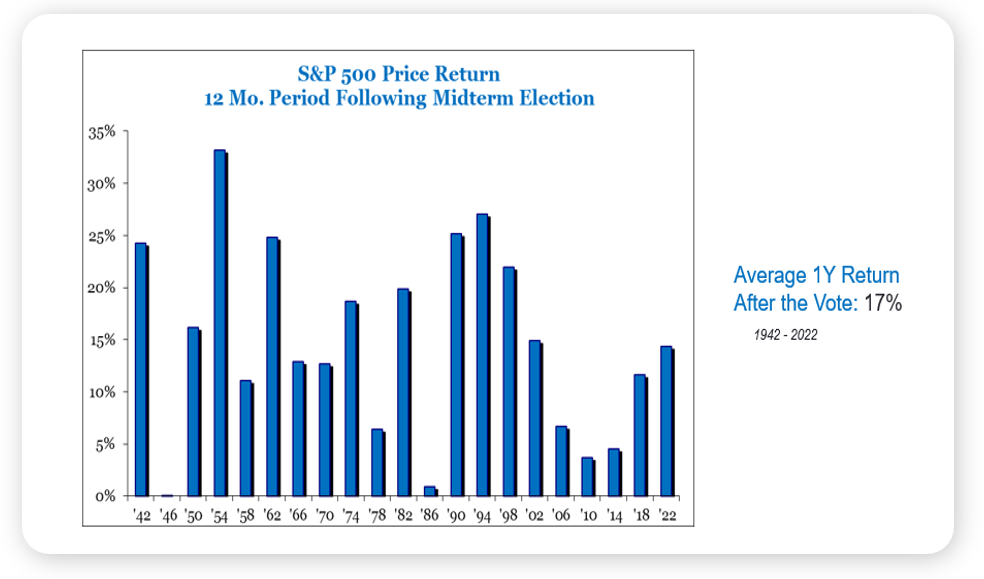
- This note should go out about 20 hours before polls open on November 3rd and Americans (at least those who haven’t cast their ballot early) vote in elections that will answer, among other key questions, what party will lead the US House and Senate for the next two years, who will reside in the Governor’s mansion in Pennsylvania and if California will impose a wealth tax. All elections are important but given our cultural and political discourse this one probably feels even more so. The focus of this note isn’t to make the case for one party or the other, one candidate or the other or one ballot proposition or the other, it is to remind us of how markets have performed post mid-terms (spoiler alert…well) and those attributes our country possesses that transcend politics, political parties and elections.
- As it concerns US equity returns post mid-terms, going all the way back to 1942, the S&P 500 has never been down 12 months on from election day and has produced an average one-year return of 17% (see below). As to why stocks have done so well once the votes are counted, most market observers would cite getting past election day and the uncertainty it presents (as we know, markets hate uncertainty) and the fact we are heading into Year 3 of the Presidential Cycle, which has historically been the strongest year by far for US equities. We should also note that markets simply go up much more than they go down.
- As it concerns those attributes our country possesses that transcend politics, political parties and elections – and will persist regardless of how the mid-terms fall out – several are worth mentioning, including that the US prints the world’s reserve currency; we are the largest producer of crude oil and natural gas on the planet; America is the leader in Artificial Intelligence; we remain earth’s preeminent military power and home to the globe’s largest, most liquid capital markets.
- As it concerns what US markets have going for them today, we would call out Q3 S&P 500 earnings growth of 30%; economic growth of 3.4% and the seasonally strong stretch of the calendar, which kicked off November 1st. We remain optimistic on the US economy and cautiously optimistic on US risk assets.
Source: Strategas, FactSet, October 2026
Looking Back, Looking Ahead
By Ben Vaske, CFA, Manager, Investment Strategy
Last Week
A sharp Friday rotation out of technology and communication services pushed major U.S. indexes lower for the week, though breadth was constructive, with nine of eleven sectors finishing positive. The S&P 500 fell just over half a percent while the equal-weighted index gained nearly 1%. Small and mid caps led, with the Russell 2000 up roughly 1.3%, while the NASDAQ 100 fell nearly 2% and growth dropped about 1.5% as value gained nearly 0.5%. Fixed income was positive as rates edged lower, with the Bloomberg Agg up just over half a percent, while commodities fell nearly 1.7% even as oil jumped back to $104 per barrel on reports that U.S. strikes in Iran may resume. For the month, October was defined by a sharp style divergence: the NASDAQ 100 fell over 6.5% and growth nearly 6%, while value gained over 4%, mid caps just over 3%, and the Dow nearly 2%. Year-to-date, value is up over 24% while growth is essentially flat, and commodities remain the standout at nearly 33%.
Earnings were the other major story. Investors looked past strong headline growth to punish Alphabet and Amazon, among others, which reported disappointing free cash flow relative to aggressive spending targets. Blended Q3 earnings growth is tracking at 30.2% with 60% of companies reported. The Fed held rates steady in a 10-2 vote, with both dissenters favoring a hike, and Q3 GDP came in at 3.4%, ahead of the 3.2% consensus, driven by strong consumer spending and a 127% surge in data center construction. September core PCE of 3.1% leaves the door open for a December hike, now priced at 71%.
This Week
Tuesday is Election Day, with prediction markets showing a 70% chance of Democrats taking both chambers, a 27% chance of a split with Republicans holding the Senate, and just a 6% chance of a Republican sweep. For investors, getting past the vote itself has historically mattered more than the outcome. With October behind us, markets also move into a seasonally strong stretch, as November has historically posted the strongest average returns of any month. Friday brings the October jobs report, with the unemployment rate expected to hold at 4.2%, and earnings remain heavy with Apple, Palantir, AMD, SMCI, Uber, and Moderna all reporting.