

















Weekly Notes from Tim

By Tim Holland, CFA, Chief Investment Officer

  • One could argue that over the past few years the primary concern for US investors – even more so than trade and tariffs; fiscal and monetary policy uncertainty (would the One Big Beautiful Bill Act pass, would government shutdowns upend the economy, would the Fed cut rates) and geo-political risk (Israel / Iran; US / Iran and Ukraine / Russia) – was over a stock market dominated and driven by a handful of large cap technology companies that would inevitably and unfortunately fall from favor and pull the S&P 500 sharply lower (we are of course referring to the Magnificent 7, which at its peak represented nearly 40% of that bellwether index).
     
  • Yet, as we take pen to paper, four of the Magnificent 7 – Microsoft, Nvidia, Tesla, and Amazon – have fallen over the prior three months while the S&P 500 has traded up by 2.7%, just shy of Apple’s 3.3% gain (see chart; through 2/6/2026). Now, three months might not a trend make and we are not rooting against the Magnificent 7 specifically or large cap US tech stocks generally, but it seems to us that US equity returns have broadened out beyond the stocks that contributed so much to the bull market that kicked off in 2022. To put a finer point on things, since early November, the Russell 1000 Growth Index is off 3.8%, while the Russell 1000 Value Index is up 10.3% and the Russell 2000, the benchmark for US small cap stocks, is up 10%.
     
  • An optimistic take on recent performance trends is that even as much of US large cap tech moves lower, the broad market is being propelled higher as other styles and sectors, including materials and industrials, and smaller companies catch a bid, which should both make for a healthier and more durable bull market (as more stocks participate in it) and speak to a more optimistic outlook for the overall economy (as a rising economic tide lifts more boats).
     
  • It's been a volatile few weeks for the market, and while the Magnificent 7 could still be the catalyst for a broad and deep sell off, for now the US bull market marches on, propelled, it seems, by the “The Forgotten 493.”
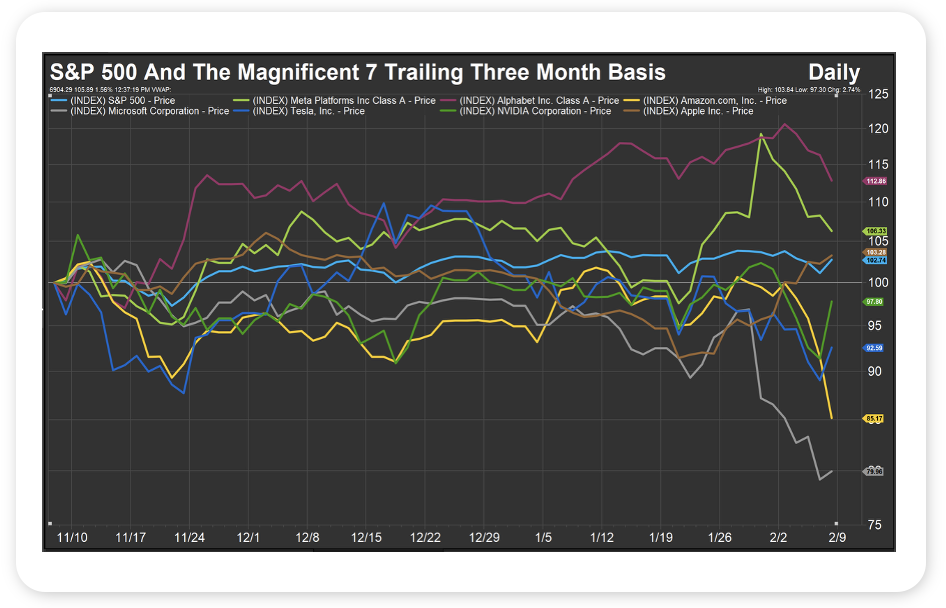
    Picture 1


Source: FactSet, February 6, 2026


Looking Back, Looking Ahead

By Ben Vaske, BFA, Manager, Investment Strategy

Last Week

Markets were choppy, with the S&P 500 finishing roughly flat after a sharp midweek selloff and a strong Friday rebound. Weakness was concentrated in technology and software, while other parts of the market continued to show strength, extending the rotation that has defined early 2026.

Performance leadership remained diversified. Small caps and value stocks each gained more than 3% on the week, and emerging markets also advanced. Small caps, value, and EM are now roughly tied as the leading equity segments YTD at just over 7%.

The temporary government shutdown ended early in the week. Manufacturing data stood out in a positive way. The ISM Manufacturing Index moved back into expansion territory at 52.6, its highest reading since 2022. While trade policy uncertainty remains a headwind, a return to expansion is a constructive signal for an industry that has struggled for several years.

The 10Y Treasury yield fell as low as 4.16% during the equity selloff before rebounding above 4.20% as markets recovered.

This Week

With the shutdown resolved, key data returns to the calendar. The delayed employment report will be released Wednesday, with expectations for the unemployment rate to hold at 4.4%. CPI and retail sales will also be released, putting labor conditions, inflation, and consumer health back at the center of the conversation within a short window.

Earnings stay in focus, particularly in software. Several names that were hit hard last week report earnings, including Robinhood, AppLovin, Coinbase, and Shopify. Given recent price declines, results and guidance could matter more than usual.

The broader takeaway remains intact. Beneath headline volatility, market breadth is improving, leadership is rotating, and pullbacks are being met with repositioning rather than panic. For long-term investors, last week was another reminder that short-term swings matter far less than staying disciplined through them.

We hope you have a great week. If there’s anything we can do to help you, please feel free to reach out to ben.vaske@orion.com or opsresearch@orion.com.
 

Get Your Own Market Commentary

Client-Friendly Weekly Wire

Want a version of Weekly Wire you can send directly to your clients? Subscribe to our Weekly Wire newsletter and get a client-friendly version every Monday. Simply download, add your firm's logo, and use with your clients!


Key Data

Stocks, Bonds, Alternatives, and Real Assets as of February 6, 2026

Security Name

Risk Score

1 Wk

1 Mo

QTD

YTD

1 Yr

3 Yr Ann.

Global Equities (60% US, 40% Intl)

100

0.06%

1.16%

3.37%

3.37%

22.77%

19.22%

S&P 500 Total Return

102

-0.09%

-0.12%

1.36%

1.36%

15.42%

20.73%

Dow Jones Industrial Average

97

2.50%

1.36%

4.35%

4.35%

13.93%

16.11%

NASDAQ 100 Total Return

122

-1.87%

-2.18%

-0.66%

-0.66%

15.98%

27.23%

TV Benchmark

107

0.18%

-0.31%

1.68%

1.68%

15.11%

21.36%

Morningstar US Large Cap

102

-0.87%

-1.09%

-0.03%

-0.03%

15.46%

22.92%

Morningstar US Mid Cap

113

2.33%

2.02%

5.45%

5.45%

11.39%

12.59%

Morningstar US Small Cap

125

3.26%

3.14%

7.27%

7.27%

15.52%

12.81%

Morningstar US Value

98

3.44%

5.15%

7.50%

7.50%

20.11%

15.35%

Morningstar US Growth

126

-0.97%

-3.17%

0.19%

0.19%

8.52%

19.87%

MSCI ACWI Ex USA

98

-0.05%

2.91%

5.93%

5.93%

34.46%

17.57%

MSCI EAFE

101

0.51%

3.32%

5.76%

5.76%

31.53%

17.27%

MSCI EM

98

-1.40%

2.72%

7.34%

7.34%

40.50%

17.42%

Bloomberg US Agg Bond Index

27

0.28%

0.40%

0.39%

0.39%

6.42%

3.99%

Bloomberg High Yield Corp Bond Index

41

0.11%

0.36%

0.62%

0.62%

7.63%

8.76%

Bloomberg Commodity Index

70

-2.20%

5.00%

7.93%

7.93%

17.77%

8.47%

Wilshire Liquid Alternative Index

25

-0.47%

0.36%

0.77%

0.77%

6.87%

5.61%

MSCI US REIT

104

3.09%

5.17%

6.26%

6.26%

6.70%

6.77%

US Dollar

10

1.60%

-0.45%

-0.51%

-0.51%

-9.07%

-1.68%

Bloomberg US Treasury Bill 1-3mo

1

0.07%

0.32%

0.37%

0.37%

4.24%

4.90%

Source: Morningstar

The TV Benchmark represents an average of the S&P 500, Dow Jones IA, and NASDAQ 100 return indexes. The Orion Risk Score represents risk relative to the global equity market.


Interest Rates as of February 6, 2026

Rate

This Week

1 Wk Δ%

13-Wk Treasury Yield

3.59%

0.02%

10-Yr Treasury Yield

4.21%

-0.04%

Bloomberg US Agg Yield

4.33%

-0.03%

Avg Money Mkt Yield

3.50%

0.00%

Avg 30-Yr Mortgage Rate

6.19%

0.01%

Sources: Yahoo Finance, S&P Global, Crane Data, BankRate


Key Economic Data Last Week

Data Point

Expectation

Actual

ISM Manufacturing

48.4%

52.6%

ISM Services

53.5%

53.8%

Job Openings

7.1M

6.5M

ADP Employment

45,000

22,000

U.S. Employment Report

55,000

DELAYED

U.S. Unemployment Rate

4.4%

DELAYED

Source: MarketWatch


Key Economic Data This Week

Data Point

Expectation

Release Date

U.S. Retail Sales - Dec

0.5%

2/10/26

U.S. Employment Report - Jan

55,000

2/11/26

U.S. Unemployment Rate - Jan

4.4%

2/11/26

Existing Homes Sales - Jan

4.15M

2/12/26

Consumer Price Index (CPI) YoY - Jan

2.5%

2/13/26

Core CPI YoY - Jan

2.5%

2/13/26

Source: MarketWatch

 
More Just for You

Want Resources for Your Clients?

Get a version of Weekly Wire you can send directly to your clients. Subscribe to our Weekly Wire newsletter and get a client-friendly version every Monday. Simply download, add your firm's logo, and use with your clients!

The views expressed herein are exclusively those of Orion Portfolio Solutions, LLC d/b/a Brinker Capital Investments, a registered Investment Advisor, and are not meant as investment advice and are subject to change. Information contained herein is derived from sources we believe to be reliable, however, we do not represent that this information is complete or accurate and it should not be relied upon as such. This information is prepared for general information only. It does not have regard to the specific investment objectives, financial situation, and the particular needs of any specific person.

An index is an unmanaged group of assets considered to be representative of a select segment or segments of the market in general, as determined by the index manager for the purposes of managing a specific index. You cannot invest directly in an index.

The CFA® is a globally respected, graduate-level investment credential established in 1962 and awarded by CFA Institute — the largest global association of investment professionals. To learn more about the CFA charter, visit www.cfainstitute.org.

Think2perform’s Behavioral Financial Advice program integrates traditional finance practices with psychology and neuroscience to improve emotional competency and decision-making behavior that increases effective usage of the financial plan with clients. To obtain the Behavioral Financial Advisor (BFA) designation, participants must complete a self-directed course, which takes 20-30 hours to complete, and includes a mix of interactive exercises, videos and case studies. To learn more about the BFA, visit https://www.think2perform.com.

Wealth management services provided by Orion Portfolio Solutions, LLC (“OPS”), a registered investment advisor. Orion OCIO services provided by TownSquare Capital, LLC (“TSC”), a registered investment advisors. OPS and TSC are affiliates and wholly owned subsidiaries of Orion Advisor Solutions, Inc.