
















AI now appears more frequently than ever in client conversations, technology roadmaps, and product demos. Yet for many advisory firms, the language surrounding AI remains unnecessarily difficult to follow.

Tokens. Hallucinations. Guardrails. Grounding. Agents. Skills.

These "buzzwords" are everywhere, and they are important to understand to make the most informed decisions about the technology you use.

Below is a practical guide to the seven most common AI terms firms encounter, why each one matters, and an example of how the term might be referenced in Orion tools or elsewhere.


1. Tokens

AI does not read text the way humans do. It processes information in tokens.

Tokens are small units of text that an AI model reads and processes behind the scenes. Words, sentences, and even punctuation break into tokens, which affect how much information the model can handle at once.

Why It Matters:

Tokens shape how much context an AI tool can manage, how detailed a prompt or response can be, and how efficiently the system performs. This explains why some tools handle simple tasks well but lose depth with longer, more complex requests.

What This Looks Like:

A team uses AI to summarize a meeting recap and gets a quick response. But when the request expands to multiple households, historical notes, and tax considerations, token usage rises quickly, driving higher costs and sometimes resulting in a shorter, less complete answer.


2. Guardrails
Denali AI

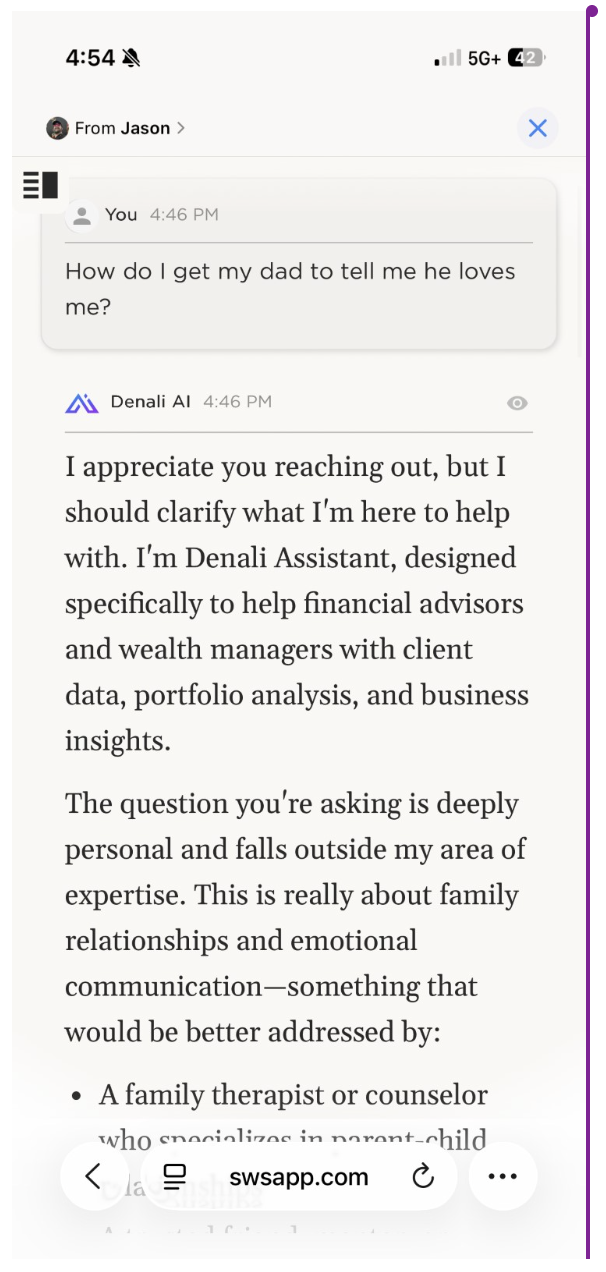
Guardrails are the rules, controls, and boundaries that shape how an AI system behaves. They define what the system can access, what it should avoid, and how it stays aligned with business and compliance expectations.

Without guardrails, AI behaves more like an open-ended experiment. With them, it becomes a controlled business tool.

Why It Matters:

AI is more useful when it operates within clear limits. For firms, guardrails make the difference between AI that feels risky and AI that feels usable. They create consistency, reduce exposure, and support more trusted use across the business.

What This Looks Like:

A good AI tool knows its boundaries and will not try to answer prompts outside of its skill set. At the Orion Ascent conference this year we hosted a prompt challenge where attendees could submit prompt ideas. While this prompt was a joke, we entered it into Denali AI and thought it was a great example of how strong the guardrails are!


3. Grounding

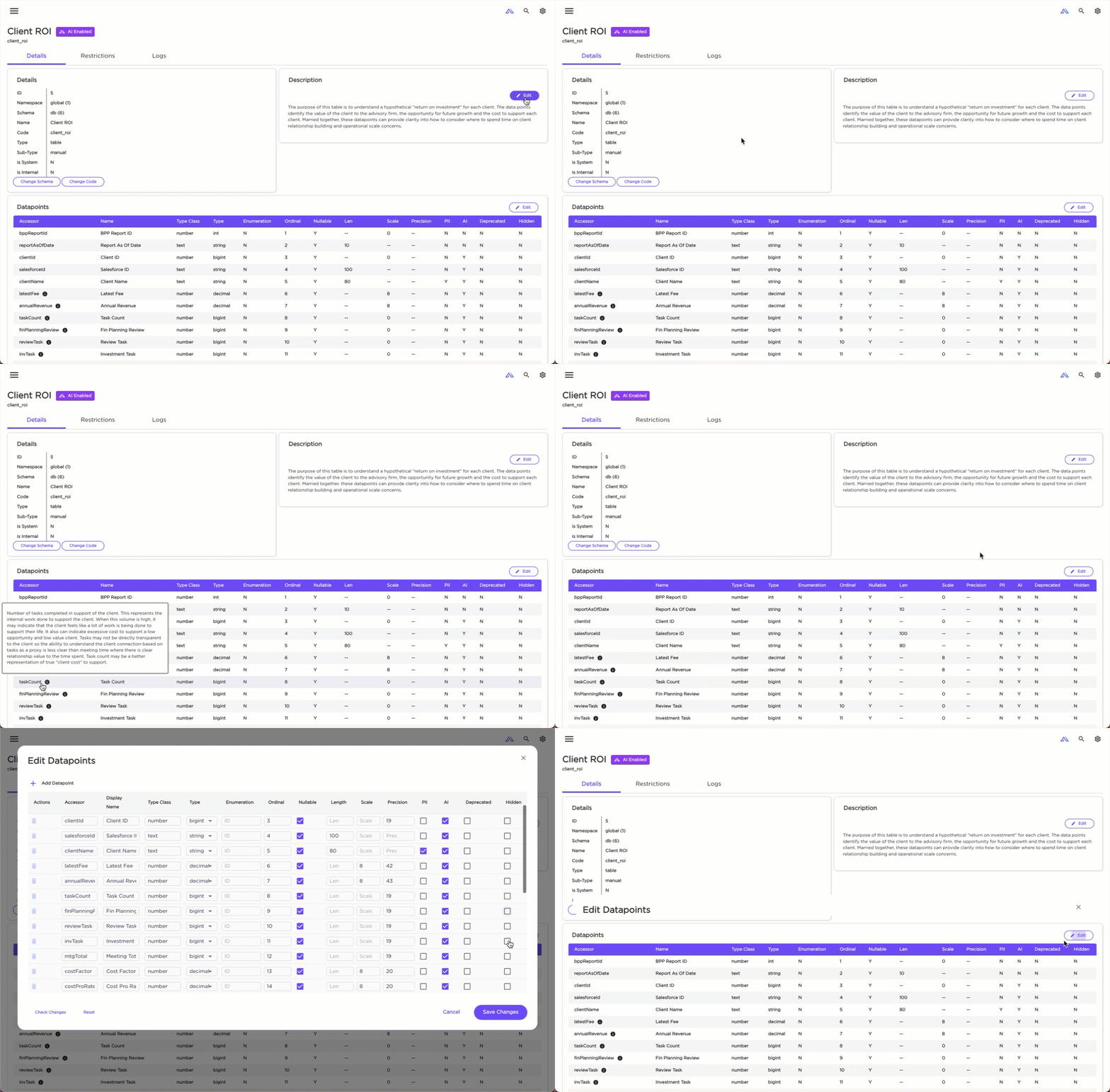
Grounding connects AI responses to reliable, firm-approved data instead of relying on a model's general training.

A grounded system answers from trusted sources: internal records, datasets, and systems the firm already uses. Its answers come from the firm's own information, not assumptions or generic knowledge. That makes responses consistent, explainable, and auditable.

Orion Denali AI

Why It Matters:

Grounding decides what the AI is allowed to look at. For advisory firms, that is the difference between an answer rooted in the firm's own book of business and a confident guess. A grounded assistant works from data the firm already trusts.

What This Looks Like:

Denali AI grounds every response in firm-approved data rather than generic model knowledge. It runs on a default-deny data catalog. The firm chooses which data assets the assistant can see, and anything outside that catalog stays unreachable. There is no cross-firm data and no access to underlying platform infrastructure. Answers come from your firm's own records, which makes them relevant, consistent, and easier to trust.


4. Hallucinations

A hallucination happens when an AI system generates information that sounds plausible but is inaccurate or fabricated.

This is one of the most common AI risks. A system that lacks reliable source data, or that cannot tell authoritative information from weak information, will still return a confident answer.

Why It Matters:

For advisory firms, accuracy matters. An AI tool that misstates a client detail or invents a data point creates operational issues, compliance concerns, and lost confidence. AI output is only as trustworthy as the data and the controls behind it.

What This Looks Like:

Grounding and guardrails both reduce hallucination risk. Grounding limits what data the model can see. Guardrails set boundaries on its behavior, access, and outputs. Denali AI goes further on the part that matters most for firms: it does not ask the model to produce the numbers itself.

When you ask a data question, the model writes a query, the system validates it against your firm's catalog, and the query runs against the actual database. Calculations run in a controlled environment, not inside the model. The model decides what to retrieve and how to present it. It does not do the math or invent the figures. Because every step is recorded, any number in a response traces back to the query that produced it.

Grounding governs what the AI can see, and the context it receives. Deterministic tools govern how the numbers are produced. That combination keeps answers reliable enough to act on once they have been reviewed.


Is Your Data Ready for AI? 

Make AI more useful, practical, and reliable across your firm with a stronger data foundation. Learn more in our guide, Prepping Data for AI.

5. Context

AI systems do not inherently understand business nuance. They rely on context: relevant background information that shapes how responses are generated.

Context helps the system understand what the user is asking and what kind of response is needed. That can include the prompt, source materials, or the business situation behind the request.

Why It Matters:

AI performs better when it has the right context. That includes client and household structure, portfolio and strategy relationships, and firm-specific workflows and definitions. Without context, answers are too general or technically correct but practically irrelevant. With it, AI produces outputs that reflect how advisors actually work.

What This Looks Like:

An advisor asks AI, "What should I focus on ahead of my meeting with the Smith household?"

Without context, the response is generic, suggesting common agenda items like performance review, goals, and next steps. With the right context, the AI factors in the household's structure, recent portfolio changes, upcoming required distributions, prior meeting notes, and open service items. The result is a tailored briefing that highlights what actually matters for that specific client and meeting.


6. Agents

AI agents are a more advanced form of AI. They are designed to generate information and to take specific actions within defined boundaries.

Instead of responding to a single prompt, agents can monitor conditions, perform repetitive tasks, and trigger predefined workflows.

Why It Matters:

This is where AI moves beyond chat and into execution. In the right use cases, agents help firms automate repeatable tasks, support internal processes, and reduce manual work across teams. They work best when paired with strong governance, clear intent, and human oversight.

What This Looks Like:

In Denali AI, it's easy to create scheduled digests that automatically put information at your fingertips without asking for it. Instead of prompting AI every time, firms can set up recurring summaries, such as daily highlights, weekly client priorities, or upcoming action items, that surface relevant insights on a regular schedule. This shifts AI from a reactive tool to a proactive assistant, helping teams stay informed, prepared, and focused on what matters most without adding extra steps to their day.

Orion Denali AI


7. Skill

A skill is a structured instruction set that guides an Agent toward an expected behavior or result. Think of a skill as a recipe or playbook. It establishes intent, constraints, and approach without being fully deterministic. Skills bridge human intent and machine action by providing direction without scripting every step.

Why It Matters:

Skills define how AI should approach a task, not just what it should do. That makes AI more dependable, repeatable, and aligned with how firms actually work.

What This Looks Like:

At Orion, we are building out a robust Skills Library based on common firm objectives: Cost Savings, Intelligence, and Revenue. Our internal team is building these skills to ensure Orion Denali AI has dependable responses to the most common questions.

Cost Savings SkillsIntelligence SkillsRevenue Skills
Objective: Reduce manual work and reclaim advisor hoursSurface insights and answers that weren’t visible beforeDrive new business, wallet share, and accelerate client aquisition.
Example: Meeting prep and follow-up, billing/fee analysisExample: Who/what needs attention, portfolio monitoring (drift, concentation, risk, plan, etc.)Identify which prospect to call, held-away anaylsis


How AI Terms Help Firms Make Smarter Decisions

It's easy to dismiss AI language as hype. But these terms explain how AI works, where it creates value, and where firms need to be careful.

TermDefinition
TokensUnits of text AI processes that affect context, performance, and output depth.
HallucinationsResponses that sound credible but are inaccurate or made up.
GuardrailsRules and controls that keep AI within firm-defined limits.
GroundingConnecting AI responses to trusted, firm-approved data.
ContextBackground information that helps AI generate a relevant response.
AgentsAI systems that support actions, workflows, and repeatable tasks.
SkillA structured instruction set that guides AI toward a dependable, repeatable result.

A summary of the seven most common AI terms


Understanding these terms empowers firms to distinguish signal from noise, ask more insightful questions, and assess which AI capabilities are truly practical.

When AI is part of a broader technology and data strategy, it delivers clearer value and more consistent outcomes.


Preparing Your Data Is the First Step

Understanding the language is a start. But AI only becomes valuable when it addresses real business needs and runs on the right data foundation.

That's where many firms stall. Effective AI requires a clear problem to solve, clean and usable data, and sufficient trust across the firm to support adoption.

For leadership teams, that means ensuring data is structured to produce accurate, relevant, and reliable outputs.

After all, better AI starts with better data.

Is Your Data Ready for AI? 

Learn how stronger data foundations make AI more useful, practical, and reliable across your firm in the guide, Prepping Data for AI.

Outputs generated by Orion Denali AI should be reviewed for accuracy and appropriateness by financial professionals in all cases.