

















Key takeaways:

  • Investors seem to be making assumptions about who the enduring AI leaders will be, even though history suggests that the AI leaders of today may not be the AI leaders of tomorrow.
  • Today’s AI stock valuations demand investors pay for certainties in the AI marketplace that we believe don’t yet exist.
  • It could be a while until the AI market’s supply and demand dynamics are settled enough to allow for stable profitability. Past technological shifts signal that it’s unclear at this stage whether current leaders or not-yet-known ones will own most of the profits.
  • Current valuations of some of the largest AI firms appear not to fully account for the R&D costs needed for ongoing innovation much less the costs to provide services using current AI models.

AI has the potential to remake our way of life, making it nothing short of revolutionary. It’s no wonder that it has stimulated investor imagination. Wall Street has made spectacular AI growth assumptions – and with high conviction – long before the economics are fully understood. History suggests that the ultimate beneficiaries in the AI ecosystem are far from certain even as investors are betting on who the enduring leaders will be.


To Boldly Go

Evidence of unbridled exuberance is becoming increasingly common. SpaceX’s IPO debuted June 12th with the intention to raise $75 billion at a market capitalization of around $1.8 trillion, making it the largest IPO ever. The 24-year-old company generated about $18.7 billion in revenue last year, so at the IPO price, investors were buying shares at something around 100 times sales. It lost roughly $4.9 billion in 2025 after being profitable a year earlier, flipping into the red when it swallowed Elon Musk’s AI venture, xAI.

Yet despite the sizable loss, the future is bright in the eyes of investors thanks to stratospheric estimates for the artificial intelligence market. According to SpaceX’s S1 filing, over 90% of the company’s estimated total addressable market of $28.5 trillion will come from its AI-related businesses.
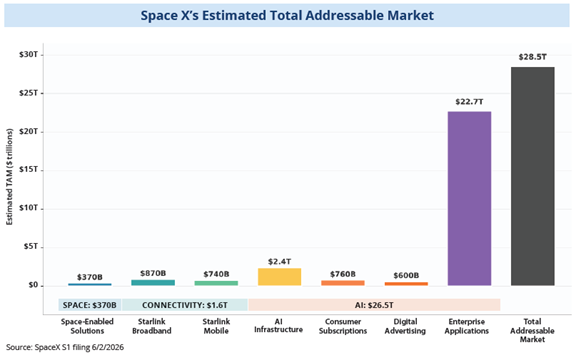
SpaceX estimated total addressable market


SpaceX is not the only blockbuster IPO anticipated this year. Anthropic said in early June that it had filed for an IPO, days after a private funding round valued the company at about $965 billion. The filing with the SEC was confidential, so details will be released nearer to the IPO, which could happen later this year.

Its direct competitor, OpenAI, has made its own confidential IPO filing. OpenAI’s valuation is expected to approach a trillion dollars based on its latest funding round, even as the ChatGPT creator may lose some $14 billion this year and expects no profit until around 2030.

Three of the largest IPOs in history could happen in succession. More importantly, all are competing in a new market with unsettled prospects and dynamics.


Priced with Certainty

The lofty growth assumptions embedded in these valuations assume the winners of the AI boom are already known with near certainty. These are the kinds of assumptions that legendary value investor Seth Klarman might take issue. In his book Margin of Safety, Klarman argued that a prudent buyer will demand an investment discount wide enough to try to account for the investment’s uncertainty. Competitive dynamics can change quickly, particularly in the technology sector. As Klarman put it, “Risk is not inherent in an investment; it is always relative to the price paid.”

Investors buying into the AI hype would argue the associated risk is being compensated with an asymmetric payoff potential. If AI turns out to be as transformative as its proponents expect, a stake in an eventual winner could return many times what it cost. The catch is that the payoff depends on market dynamics that have yet to be established. Specifically, the market for tokens.

 

The Cost of a Thought

A token is roughly three-quarters of a word, the basic unit that a language model reads and writes. The cost to process one has fallen perhaps sixty-fold in two years and is still falling. Even so, corporate AI bills keep climbing because cheaper tokens have spurred far heavier use. A task that was once a single query is now an autonomous agent that runs for hours and calls the model hundreds of times.

Whether tokens are priced above cost depends on which cost one measures. Serving an additional token on hardware already paid for appears profitable. But, to paraphrase Anthropic’s CEO and co-founder, Dario Amodei, running a trained model is profitable if you don’t count the research and development that went into it and the future research and development needed to create new, cutting-edge models. Once you account for the original training of the model, research payroll and the far larger cost of training each successor, the profitability equation changes. How and when that gap gets filled looms over the valuation question.


Second Thoughts

For the business model to work, token prices must stay below the value customers believe they receive. So far, there is no evidence of that return. A widely cited MIT study last year found that roughly 95% of organizations earned no measurable return on their generative-AI spending. Recent anecdotes highlight the questionable cost-benefit proposition. Microsoft recently cancelled most of its internal licenses for a popular AI coding tool over cost, and Uber’s operating chief has called the spending hard to justify.

Cheaper intelligence, like cheaper bandwidth before it, may unleash enough new demand. Or buyers may grow disciplined and rein in usage well before that point. Whether current AI leaders grow into their valuations or chase them for years will depend on if they (or some yet-to-be known companies) achieve a profitable supply/demand dynamic in their markets.


The Leader’s Curse

Even if abundant demand materializes as hoped, the question of who captures the profit remains open. History is littered with cautionary tales. Railroads transformed the nineteenth-century economy and bankrupted many who financed them.

The most recent parallel is the late-1990s telecom build-out. Cisco, which was regarded as the clearest leader and safest bet, lost roughly 80% of its value and languished for years, while the firms that laid the fiber went bankrupt. The cheap, leftover capacity became an advantage for companies like Google and Amazon. The economist Carlota Perez has described a common pattern where companies overinvest in a frenzy to build infrastructure while the profits accrue to entirely different hands.

One concerning feature of this industry is the circular nature of the spending and investment. Anthropic’s latest round was funded largely by its own suppliers, the memory makers Samsung and SK Hynix and the cloud provider Amazon. Nvidia has invested $30 billion in OpenAI, a major buyer of Nvidia chips. Telecom did a version of this in 1999, when equipment makers financed the customers who bought their equipment, promoting demand until the crash.


Promise and Prudence

This is not intended to dispel the promise of AI.

A best-case scenario is undoubtedly on the table as valuations imply, but it’s also not the only possible outcome. The technology is real and may well justify the valuations of today’s AI leaders over time.

But the lesson of every prior mania is that being right about the technology tells an investor little about which companies stand to benefit. The danger is compounded by equity index concentration in companies related to AI, which is set to increase with the inclusion of a trio of newborn mega-caps.

Until the industry settles, we believe that valuations expect investors to pay in advance for a certainty that does not yet exist. It’s exactly the environment in which disciplined risk management, rather than blind conviction, protects capital, in our view.
 

Access Ocean Park's
Model Lineup on Orion

Expand your offering and unlock new opportunities with direct access to Ocean Park's model lineup, integrated seamlessly into Orion platforms.

Learn More

ABOUT THE AUTHOR

James St Aubin

James St. Aubin, CFA®, CAIA®, is Chief Investment Officer for Ocean Park Asset Management. He has oversight of all Investment Management department activities, in collaboration with Co-founders David Wright and Kenneth Sleeper. An experienced investment management executive, his career of more than 20 years includes leadership roles in asset allocation, manager research and portfolio construction. James earned a Bachelor of Science in Finance from DePaul University and is a CFA® and CAIA® Charterholder.


RISKS AND DISCLOSURES:

This blog is sponsored by Ocean Park Asset Management. Orion Advisor Solutions, Inc. (“Orion”) or its affiliates and subsidiaries received compensation from Ocean Park Asset Management for the placement of this advertisement content. Ocean Park Asset Management and Orion are not affiliated companies, and the advertisement is not a recommendation or endorsement by Orion for any of the services referenced or provided.

This website may contain links to third-party websites. Any links to such third-party websites are provided solely as a convenience to you and not as an endorsement by Orion of the content on such third-party websites, or any affiliation or association with its operators. Orion is not responsible for the content of linked third-party websites, including, without limitation, any link contained in a linked website, or any changes or updates to a linked website, and do not make any representations regarding the information, services, products or accuracy of any material contained on such third-party websites.

This material does not constitute any representation as to the suitability or opportunities of any security, financial product or instrument. There is no guarantee that investment in any program or strategy discussed herein will be profitable or will not incur loss. This information is prepared for general information only. Individual client accounts may vary. It does not have regard to specific investment objectives, financial situation, and the particular needs of any specific person who may receive this report (information). Investors should seek financial advice regarding the appropriateness of investing in any security or investment strategy discussed and should understand that statements regarding future prospects may not be realized. Investors should note that security values may fluctuate, and that each security’s price or value may rise or fall. Accordingly, investors may receive back less than originally invested. Past performance is not a guide to future performance. Investing in any security involves certain non-diversifiable risks including, but not limited to, market risk, interest-rate risk, inflation risk, and event risk. These risks are in addition to any specific, or diversifiable, risk associated with particular investment styles or strategies.

Wealth management services provided by Orion Portfolio Solutions, LLC (“OPS”), a registered investment advisor. Orion OCIO services provided by TownSquare Capital, LLC (“TSC”), a registered investment advisor. OPS and TSC are affiliates and wholly owned subsidiaries of Orion Advisor Solutions, Inc.

Information presented herein with respect to any third-party service provider has been provided by those third-party service providers and has been reproduced here with their permission. Such information does not necessarily reflect the views and opinions of Orion Advisor Solutions, Inc. (“Orion”) or its affiliated companies. Orion does not endorse any particular third-party product or service. Our clients should undertake their own assessments to determine whether these parties meet their business and due diligence requirements. Ocean Park Asset Management and Orion Portfolio Solutions, LLC (“OPS”) are not affiliated companies, and the blog is not a recommendation or endorsement by OPS for any of the services referenced or provided. While some OPS solutions may contain one or more of the specific strategies mentioned, OPS is not making any comment as to the suitability of these, or any investment product for use in any portfolio.

These materials may not be copied, altered, or redistributed without the prior written consent of Ocean Park Asset Management, LLC. This information is for educational purposes and is not intended to provide, and should not be relied upon for accounting, legal, tax, insurance, or investment advice. This does not constitute an offer to provide any services nor a solicitation to purchase securities. The contents are not intended to be advice tailored to any particular person or situation.

Unless otherwise noted or sourced within, the statements herein are the opinion of the author. The statements have been made based on publicly available information and proprietary research but remain the opinion of the author unless noted otherwise. We do not guarantee the accuracy or completeness of the information provided in this document. All statements and expressions herein are subject to change without notice. Any projections, market/ economic outlooks or estimates herein are forward-looking statements based upon certain assumptions and should not be construed to be indicative of the actual events that will occur. Other events that were not taken into account may occur and may significantly affect the statements made herein. Except where otherwise indicated, the information and statements provided herein are based on matters as they exist as of the date of preparation and not as of any future date, and we are under no obligation to correct, update or revise the information in this document or to otherwise provide any additional materials.

Ocean Park Asset Management, LLC is a registered investment advisers (“RIA”) regulated by the U.S. Securities and Exchange Commission (“SEC”). The use of the term “registered” does not imply any particular level of skill or training and does not imply any approval by the SEC. For information pertaining to the registration status of Ocean Park Asset Management, LLC, please call 1-844-727-1813 or refer to the Investment Adviser Public Disclosure website (www.adviserinfo.sec.gov).