





















Key Takeaways
- Emerging markets indexes are becoming increasingly concentrated in a small number of specific companies, sectors, and countries. Investors should be aware of what’s been driving returns and what the market’s expectations are for EM.
- As a result, the key themes driving both risk and returns in EM are growing more similar to those in US equities. Investors need to understand how exposed they are to certain themes.
- EM’s exposure to these secular growth trends have led to significantly higher growth forecasts while still trading at a significant discount to the US, and Orion’s Asset Allocation Committee modestly favors EM relative to developed markets, but opportunity extends beyond South Korea and Taiwan. Active management and thoughtful, diversified asset allocation can allow for suitable participation while curbing tail risks relative to passive indexes.
The secular growth trends of AI capex and natural resource demand have been key drivers of global economic growth and market returns, and no equity class has benefitted more than emerging markets.
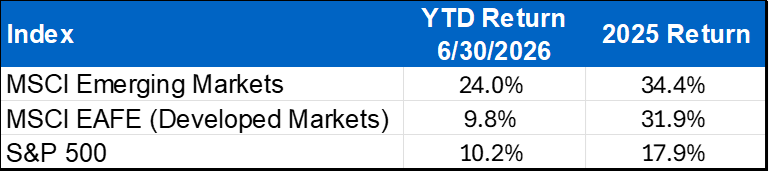
Source: Morningstar Direct as of 6/30/2026
Thanks to these gains, advisors may be facing one of two realities:
- Clients owned emerging markets during this rally, and EM now makes up a larger portion of their portfolios than before.
- Clients did not own emerging markets and are now wondering if they should add EM exposure to their portfolios.
Either way, it’s going to be important to understand what’s been happening in emerging markets and what the market is pricing in for the future. Let’s break it down.
Taiwan Semiconductor, Samsung, and SK Hynix – the East Asia AI Darlings
These three companies have become critical chokepoints in the AI capex ecosystem, rocketing their earnings growth prospects and market values.
- Taiwan Semiconductor Manufacturing Company (TSMC) is the world's largest and most advanced semiconductor foundry. Companies like Nvidia, Apple, AMD, and Broadcom design their own chips but don't manufacture them; they rely on TSMC to build them. Its market share in global foundry service providers was 72% in 2025.
- South Korean companies Samsung Electronics and SK Hynix are the world’s leading memory providers – operating in the same space as American company Micron Technologies. These firms supply the high-bandwidth memory that goes into AI GPUs like Nvidia's, and also sell conventional memory directly to the hyperscalers for their data-center builds.
As AI capex projections began to materialize in late 2025 and early 2026, these three companies received massive capital flows. From the beginning of 2026 to the last week of June, TSMC was up +53%, Samsung +150% and SK Hynix +200%. While this rally has been lucrative for EM investors, it has left the EM index in an interesting (for some, precarious) situation:
- Company Concentration: TSMC, Samsung, and SK Hynix now make up 31% of the MSCI Emerging Market Index, which has nearly 1,200 constituents.
- Country Concentration: Taiwan and South Korea now account for 51% of the index. Add in China and India, and four Asian countries make up 81% of an index that includes 24 countries across five continents.
- Sector Concentration: Information Technology now makes up 45% of the index, nearly doubling its weight in a year and pushing every other sector exposure lower:
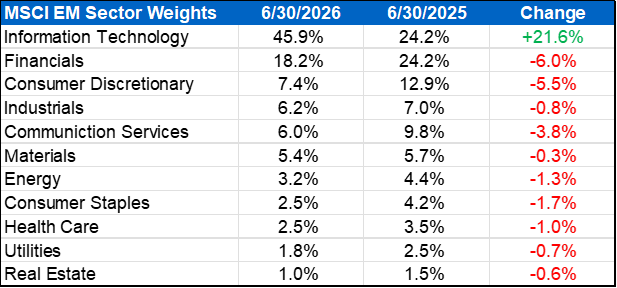
Source: MSCI Indexes as of 6/30/2026
Sound Familiar?
Because of this expansion in technology exposure, emerging markets have become integrated with the secular AI theme that’s also a primary growth driver for US markets. You can see how the ecosystem is connected between these markets:
- Chip designers like Nvidia and AMD are reliant on TSMC for manufacturing and Samsung/SK Hynix/Micron for memory.
- Hyperscalers like Microsoft, Meta, Google, and Amazon are reliant on Nvidia’s chips and Samsung/SK Hynix/Micron’s memory for their data center buildouts.
- The hyperscalers are the primary spenders, and the semis/memory suppliers are the primary recipients of this revenue.
The result for diversified investors: your emerging markets sleeve may be increasingly exposed to the same risk factors as a significant portion of your US equities, the most obvious of which is a potential slowdown in spending from the hyperscalers.
EM Remains Attractive, but Consider if Suitability has Shifted
None of this is to say that emerging markets aren’t an attractive investment option right now. The asset class maintains strong expected growth rates yet trades at a discount of about 25% US equity valuations. In fact, our Asset Allocation Committee modestly favors EM over DM due to its strong fundamentals and attractive relative valuations. EM’s forward and blended PEG ratios, which measure how much investors are paying for each unit of earnings growth (generally speaking, the lower the PEG ratio the better), are at sharp discounts to the US and developed international markets, as well as their own historical averages. The forward PEG ratio relates a company’s forward twelve-month earnings to its growth rate, while the blended PEG uses an average of forward and trailing twelve-month earnings.
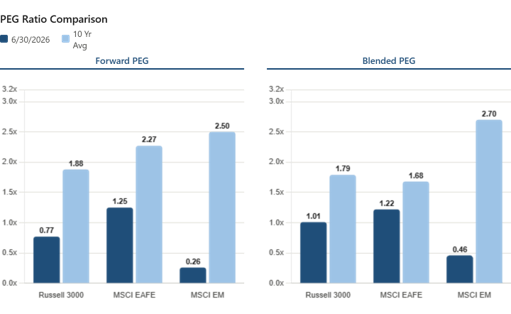
Source: Bloomberg, MSCI Indexes, as of 6/30/2026
Although fundamentals for EM equities appear intact, a question that needs to be considered is suitability, and whether it’s changed for some clients in the past year. For aggressive clients seeking significant exposure to the disruptive AI theme, there may be nothing wrong with the current state of passive EM exposure – it can provide a differentiated angle to the core theme defining this decade.
For other clients, however, the changes to EM’s market structure may present new risks that need to be addressed. Active management and careful manager selection may help investors maintain an allocation to EM equities while potentially curbing some of the tail risks presented by the increasingly concentrated indexes. Opportunities exist outside of Taiwan and South Korea.
- Nearshoring in Latin America stands to provide a tailwind to local manufacturers as companies diversify supply chains away from China.
- Southeast Asia, with strong domestic demand and a broad mix across manufacturing, consumption, and resources, offers a lower-correlation counterweight to the AI-driven industries concentrated in East Asia.
Active managers can allocate to these potentially underappreciated corners of the EM universe while still maintaining healthy exposure to technology and the AI theme. An intentional conversation with clients to understand if their suitability for passive emerging markets exposure has changed may go a long way in managing portfolio risk during this market cycle.