




















Key takeaways:
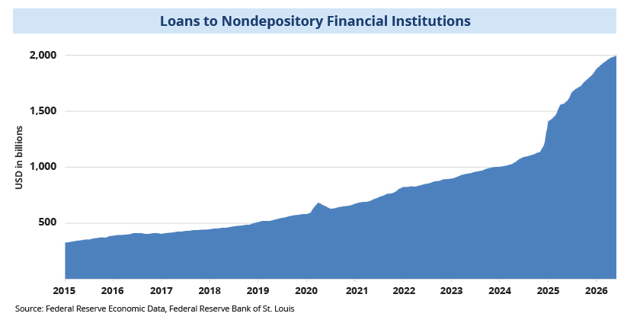
- Private credit investing has exploded in growth, with the private credit market valued
north of $1.6 trillion. - There are signs of risks emerging that could bear some similarity to the early warnings that we saw with subprime in 2007.
- The valuation methods for private credit holdings and other factors may obscure risks.
- Investor focus on artificial intelligence may be distracting from the private credit risk at hand, including its potential knock-on effects on the broader market.
In March 2007, then Federal Reserve Chairman Ben Bernanke told Congress that the problems emerging in subprime mortgages seemed “likely to be contained.” He was describing a corner of the credit markets that most investors had never examined closely, one that had grown quickly and quietly. Nineteen years later, a different corner of the credit markets is generating its own “containment assurance.” The International Monetary Fund said in April that turmoil at private credit managers including Blue Owl, Ares and Blackstone appears limited, with the potential for a “contained systemic impact.” The similarity was potentially ominous, if not unavoidable.
Shadow Banking
Private credit is direct lending outside the banking system. The asset class took shape after the 2008 financial crisis, when new capital rules made it expensive for banks to hold risky corporate loans, and investment funds stepped in to lend directly to mid-sized companies. The pitch to borrowers was speed and flexibility. The proposition to investors was yield, often at a premium to public market corporate credit, in exchange for illiquidity. The Office of Financial Research now puts U.S. private credit commitments above $1.6 trillion, larger than the domestic broadly syndicated loan and high yield markets.
For most of its life, private credit has been an institutional product. That changed with the rise of the non-traded business development company (BDC), a vehicle that packaged private loans into an evergreen fund with monthly purchases and quarterly redemptions that are typically capped at 5% of net asset value. These structures brought this asset class to a much broader retail audience, touting double-digit yields in a semi-liquid format. Wealth platforms embraced them and the non-listed BDC market crossed $200 billion in aggregate NAV late last year. The structure worked well as long as money moved in one direction.
Rushing for the Exits
That direction began to reverse last fall. The bankruptcies of subprime auto lender Tricolor and auto parts maker First Brands prompted JPMorgan CEO Jamie Dimon to warn that looser underwriting, opaque ratings and illiquid vehicles could echo the subprime meltdown. Then, in early 2026, a new source of investor anxiety emerged. Software companies feature prominently in many private credit portfolios, and concerns about AI disruption of software-as-a-service business models raised questions about credit quality in loans underwritten.
Private credit purveyors added their own fuel to the fire. Blue Owl announced plans in November to merge its unlisted BDC, OBDC II, into its listed BDC at net asset value, and the market response was swift. Blue Owl’s stock dropped nearly 11% over eight trading days before the firm canceled the deal. Weeks later, BlackRock TCP Capital disclosed write-downs that cut its NAV by 19% in the fourth quarter. In February, Blue Owl closed quarterly redemptions on OBDC II altogether and sold $1.4 billion in loan assets to raise cash.
According to investment banking advisory firm, Robert A. Stanger & Company, publicly registered non-listed BDCs met about $6.9 billion of redemption requests in the first quarter while more than $6 billion in requests went unmet, with gross sales 59% below a year ago at $4.9 billion. For the first time in the sector’s history, more capital left non-listed BDCs in a quarter than came in.
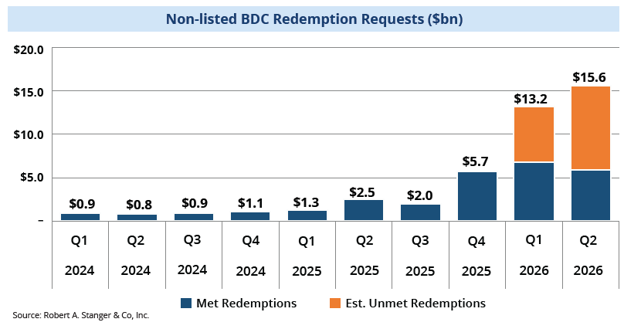
The second quarter brought another $5.9 billion in redemptions met, lifting the year-to-date total to nearly $13 billion. Requests kept running well past the caps at the largest funds. Apollo Debt Solutions disclosed second-quarter demand of 16.8% of shares against the 5% it honored, and Morgan Stanley’s North Haven fund prorated requests at 43 cents on the dollar. The pressure is not uniform. Oaktree’s fund saw demand ease below its cap and Goldman’s vehicle fulfilled every request. Managers argue the gates are functioning exactly as designed, which is little consolation for investors seeking a return of their capital.
Price Discovery
The wave of redemptions is shining a light on a known issue with the asset class. Private loans do not trade, so their values are estimates. Managers set marks quarterly with input from valuation agents hired by those same managers. The potential for conflict of interests is clear. Higher marks mean higher fees, steadier performance and calmer investors.
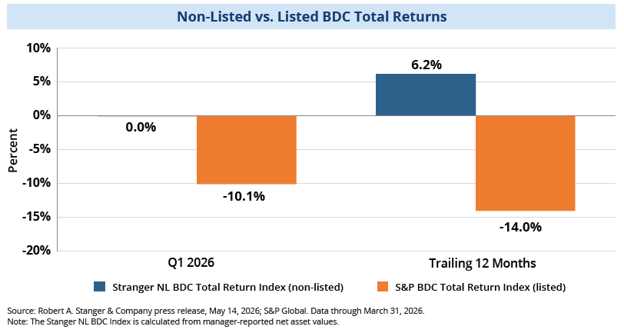
The public market has been offering a second opinion. Stanger’s index of non-listed BDCs was essentially flat in the first quarter at -0.03%, while the S&P BDC index of listed funds fell -10.1% in the quarter and -14% over the trailing year. Both sets of listed and non-listed BDCs hold broadly similar loans to broadly similar companies. The gap between them is not a difference in exposure, but rather a difference in who sets the price.