





















Key Takeaways:
- AI investment is rapidly reshaping hyperscaler cash flows, with capital expenditures growing significantly faster than operating cash flow as companies build out data centers, chips, power and other AI infrastructure.
- Free cash flow is coming under pressure even at highly profitable technology companies, with Alphabet reporting its first negative free cash flow quarter and hyperscalers increasingly turning to external financing to support continued AI investment.
- The key question for investors is shifting from how much companies are spending on AI to whether those investments generate sufficient returns, making capital intensity, cash flow, financing strategies and differences among hyperscalers increasingly important to monitor.
For years, the largest technology companies produced so much cash that investors rarely had to think about how their growth was funded. Artificial intelligence is beginning to change that equation.
Amazon, Alphabet, Microsoft and Meta spent approximately $165 billion on capital expenditures in the second quarter of 2026 alone, supporting enormous investments in data centers, chips, power and other AI infrastructure. Importantly, this spending is occurring while the underlying businesses remain strong. The concern is not that struggling companies are throwing money at AI. It is that even some of the world's most profitable companies are beginning to spend cash faster than they generate it.
Alphabet offers perhaps the clearest example. The company generated $39.1 billion of operating cash flow during the second quarter, but capital expenditures reached $44.9 billion, pushing quarterly free cash flow to approximately negative $5.9 billion. It marked Alphabet's first negative free cash flow quarter as a public company. Amazon has experienced a similar squeeze, with trailing 12-month free cash flow moving into negative territory even as AWS revenue continues to grow rapidly. Microsoft remains an important counterpoint, maintaining positive free cash flow and demonstrating why investors should not treat every hyperscaler as financially identical.
The broader trend, however, is difficult to ignore. AI is transforming some of the world's most asset-light, cash-generative businesses into increasingly capital-intensive companies.
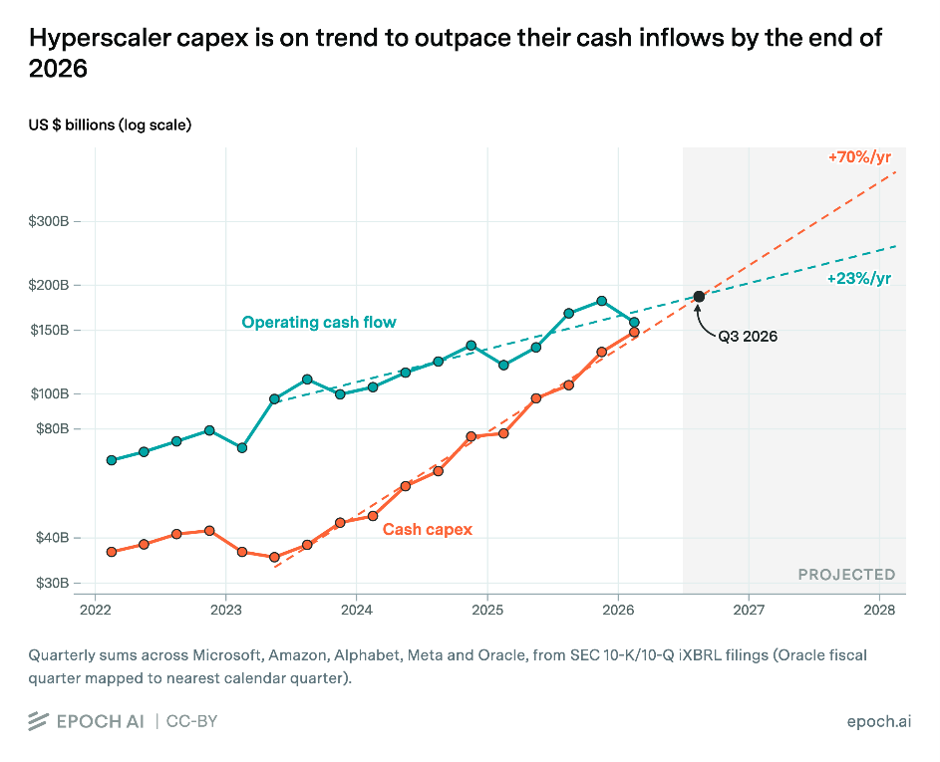
Source: Epoch AI
From the second quarter of 2023 through the first quarter of 2026, aggregate operating cash flow across Microsoft, Amazon, Alphabet, Meta and Oracle grew at an annualized trend of approximately 23%. Cash capital expenditures grew at roughly 70%. Extend those trends forward and the lines converge around the third quarter of 2026, effectively pushing aggregate free cash flow toward zero.
The important point is not whether the crossover occurs in precisely Q3. It is how quickly the two lines have converged.
Goldman Sachs' estimates illustrate the potential magnitude of that timing mismatch. After reaching record levels in 2024, aggregate quarterly free cash flow across the major U.S. hyperscalers is expected to decline sharply and turn negative in several quarters through 2027. Importantly, Goldman also expects that pressure to eventually reverse, with free cash flow recovering meaningfully into 2028 and 2029. That makes the chart less a warning that AI investment is unsustainable and more an illustration of the bet investors are making: significant cash flow is being sacrificed today in anticipation of substantially greater returns tomorrow.
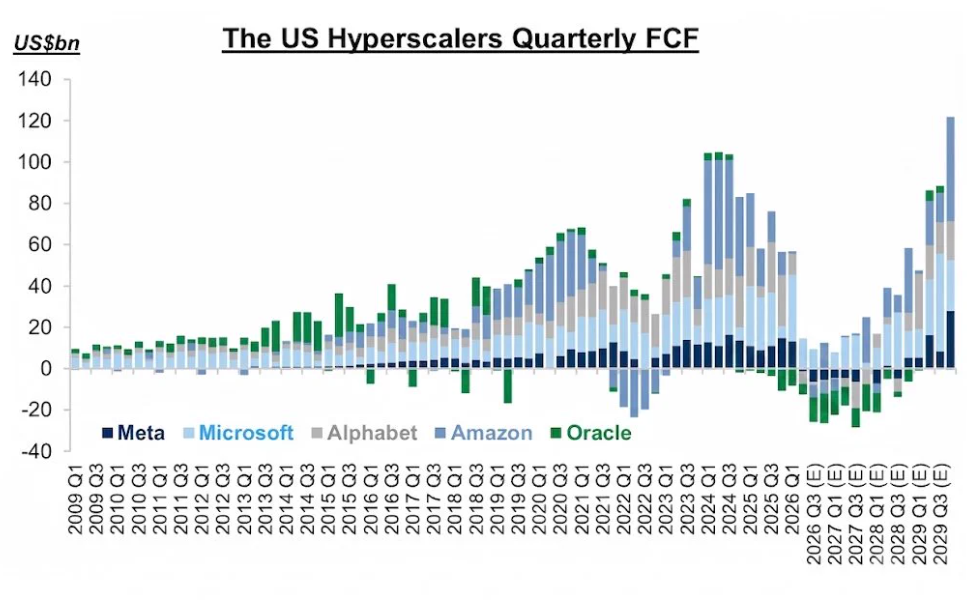
Source: FactSet, Goldman Sachs Global Investment Research
That gap is now demanding increasing levels of external investment. Historically, hyperscalers could finance most investments directly from their enormous operating cash flows. Now, however, they are turning to capital markets. FactSet estimates incremental annual debt among Alphabet, Amazon, Meta, Microsoft and Oracle increased from just 9% of capital expenditures in fiscal year 2024 to 32% on a trailing 12-month basis by mid-2026.
That represents a meaningful structural shift. When the world's most profitable companies begin funding growth through debt, equity and external financing rather than almost exclusively through their own cash flows, the risk associated with the AI buildout begins to spread beyond the hyperscaler income statements. These companies remain profitable and generally have strong balance sheets, but the margin for error is changing. On the positive side of the ledger, the spread or incremental yield demanded by investors buying the debt issued by technology companies only slightly exceeds that of the broader corporate issuance universe, and that spread has remained relatively tame despite anticipated growth in issuance.
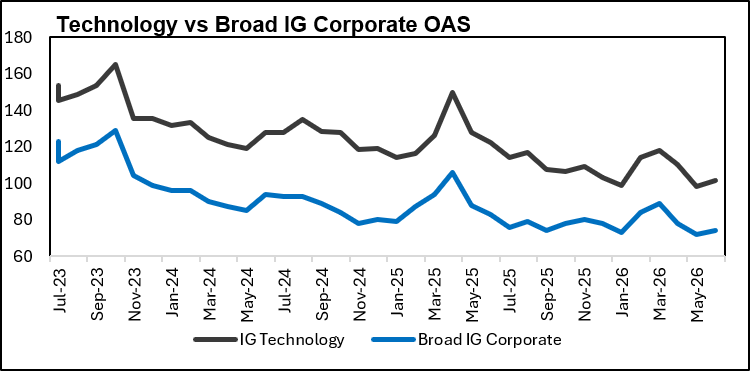
Source: Bloomberg
Ultimately, the next stage of the AI story may be less about spending and more about return on investment. There is a compelling bullish scenario in which AI adoption accelerates, cloud revenue continues growing and operating cash flow eventually catches up with today's investment. But investors also need to consider what happens if monetization takes longer than expected. Hundreds of billions of dollars cannot be invested indefinitely without producing an adequate return on that capital.
For advisors, this is certainly not a call to abandon AI exposure, but rather to start keeping a closer eye on fundamentals beyond earnings growth. Watching the relationship between capital expenditures and operating cash flow may become increasingly important, particularly in portfolios with concentrated mega-cap technology exposure. Investors should also distinguish among the hyperscalers rather than treating them as a single AI trade, as their cash generation, capital intensity and financing strategies increasingly diverge.
The AI spending boom is clearly real. The next question is whether the cash flows arrive quickly enough and are substantial enough to justify it.