





















Our investment team is closely monitoring the developments in the Middle East and the impact they are having on commodity prices, the stock market, and the world economy. We lament the loss of innocent life, pray for the safety of U.S. troops in harm’s way and mourn the U.S. military servicemembers who have lost their lives.
You will continue to hear from us on the conflict with Iran. In the meantime, if you have any questions on the markets and the economy or if there is anything we can do to support you and your clients during this difficult time, please reach out to us via our Investment Strategy Team’s email address at opsresearch@orion.com.
Weekly Notes from Tim
By Tim Holland, CFA, Chief Investment Officer
- We hope you all had a wonderful Labor Day weekend! It is hard to believe another summer is in the books, but the older I get, the quicker the calendar pages flip.
- And I was thinking about my professional past as I focused on this week’s note. Before getting into investments, I spent seven years working in public relations for capital markets firms – mostly investment banks and investment managers – and it was that work and my interest in what my clients were doing for a living that ultimately led me to a career in finance. Now, a maxim of the PR Industry is “Never pick a fight with people who buy ink by the barrel,” the idea being you can’t win an argument against a newspaper – or any media outlet – due to their platform, reach and ability to always get the final word. Well, this week I am going to ignore that sage advice and pick just the tiniest of fights with the financial media over its recent coverage of the US bond market.
- More than one media outlet has described recent stress in the bond market as a “rout” while others have used “soar” or “soaring” to describe the rise in bond yields. And those folks are right that the bond market has seen better days…the yield on the US 30 Year Note recently hit a 19-year high, the yield on the US 10 Year Note just hit a near three year high and the iShares Core Aggregate Bond ETF is off 0.30% in 2026. As to why yields have risen, most market observers would cite concerns over inflation, and the US deficit and debt, and competition for capital from AI hyper-scalers. That written we think some perspective is in order.
- At 4.75%, the yield on the US 10 Year Note remains below where it was from the 1970s through the 1990s, a period when the US ran smaller deficits, had less debt and a higher rate of inflation (see chart; the yield on the US 30 Year Note exhibits the same historical pattern). One could also argue that the resetting of yields will prove healthy for the economy long term as it reflects a more realistic cost of capital, following a decade+ of abnormally low yields brought on by the Global Financial Crisis and accommodative central banks. Said differently, the bond market’s behavior today isn’t an outlier; its behavior during the 2010s and through the pandemic was.
We don’t make light of the fact higher yields will mean higher borrowing costs for consumers, companies and our country, a dynamic that will prove painful for many. We also don’t dismiss the risks years of excess US government borrowing could present to the economy. We just don’t see recent bond market behavior as a rout and think it could have been reported on a bit differently. And we don’t see current bond yields representing a real risk to the economy or the stock market.
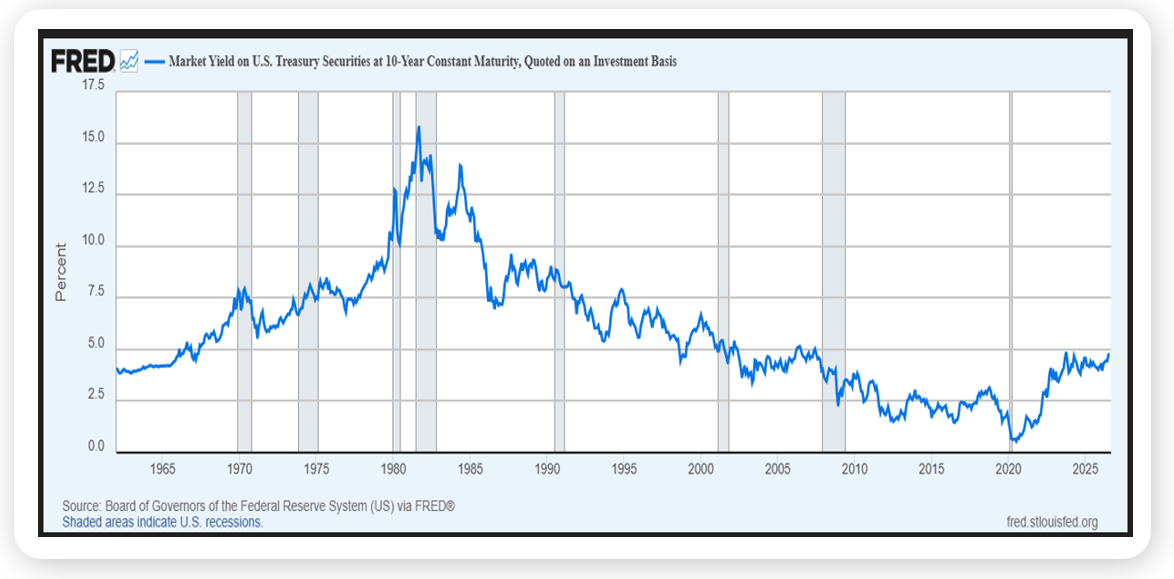
Source: Federal Reserve Bank of St. Louis 2026
Looking Back, Looking Ahead
By Ben Vaske, CFA, Manager, Investment Strategy
Last Week
U.S. equity markets were largely flat to mixed last week as a blowout jobs report and renewed geopolitical tensions pulled in opposite directions. The S&P 500 gained just over 0.1% and the NASDAQ added just under half a percent while the Dow slipped slightly negative. The rotation out of growth that has defined the third quarter continued, with U.S. growth down nearly 2% for the month and over 4% on the quarter, while value has held up considerably better. Commodities gained roughly 2% on the week as WTI crude oil surged about 9% to close near $93 per barrel, extending their position as the leading asset class over the trailing 12 months with a gain of over 44%.
The August nonfarm payrolls report was the week's defining data point. The economy added 162,000 jobs against a consensus expectation of just 53,000, and prior months were revised higher by a combined 55,000, erasing the previously reported negative July reading entirely. The unemployment rate held at 4.1%, and the report pushed September rate hike odds roughly 10 percentage points higher to 60%. ISM Manufacturing came in at 54.6, its eighth consecutive month of expansion, while ISM Services rose to 55.4, beating expectations and marking nine straight months above 53. The Atlanta Fed's GDPNow estimate for Q3 growth ticked up to 4.7%, and Q3 earnings estimates are being revised higher by analysts, an unusual development this early in the quarter that suggests the fundamental earnings backdrop remains stronger than the macro uncertainty implies.
This Week
Inflation takes center stage in a busy, holiday-shortened week. PPI is due Thursday and CPI on Friday, where a 3.4% year-over-year reading is expected, arriving just days before the September 16th FOMC meeting. A 10-year Treasury auction on Wednesday will provide a real-time read on bond market appetite ahead of the rate decision. The ECB also announces its rate decision Wednesday, as European policymakers navigate similarly sticky inflation. On the earnings calendar, Oracle and Adobe headline an otherwise quiet week as the market turns its attention toward Q3 season, where current estimates call for 28.5% year-over-year earnings growth, which would mark the third consecutive quarter above 25%.