





















Key Takeaways:
- While the Federal Reserve did increase the Federal Funds Rate for the first time since 2023, it also signaled that this is likely just a brake pump and not the beginning of a new, aggressive hiking cycle.
- Historically, equities have been able to continue running in the face of slow or light tightening cycles, and the secular themes driving earnings growth at the index levels are somewhat insulated from interest rate risk.
- Given the Fed’s outlook for the near-term path of interest rates, we remain cautiously optimistic on US risk assets and don’t see rate hikes as likely to hamstring the economy or the current bull market.
At last week’s meeting, the FOMC made its first move of the Kevin Warsh era, unanimously raising the Federal Funds Rate 25 basis points to a 3.75%–4.00% target range. With the aggressive hiking cycle and bear market of 2022 still close in the rearview mirror, clients may be asking what this move means for their equity portfolios. Today we’ll break down the Fed’s message, analyze the backdrop into which they decided to hike, and look at historical equity performance around initial rate hikes.
The Fed’s Message & the Current Backdrop
It seemed to us that Warsh’s goal for last week’s meeting was to establish credibility and faith in his Fed’s willingness to fight inflation. When he was appointed, Warsh stated that he had “zero tolerance” for inflation running above the Fed’s target, and last week he stated that while “inflation remains elevated… today’s policy action will support a timelier return to the Committee’s 2 percent goal. This Committee will deliver price stability.” However, Warsh refrained from characterizing this move as a sharply hawkish decision, arguing that the Fed Funds Rate is still not in restrictive territory, but rather that the Committee merely “removed a dose of accommodation.”
The Fed is facing a difficult backdrop of higher supply-driven headline inflation, due largely to the closure of the Strait of Hormuz, against declining core inflation (ex-food and energy) which recently dipped to its lowest level in over five years.
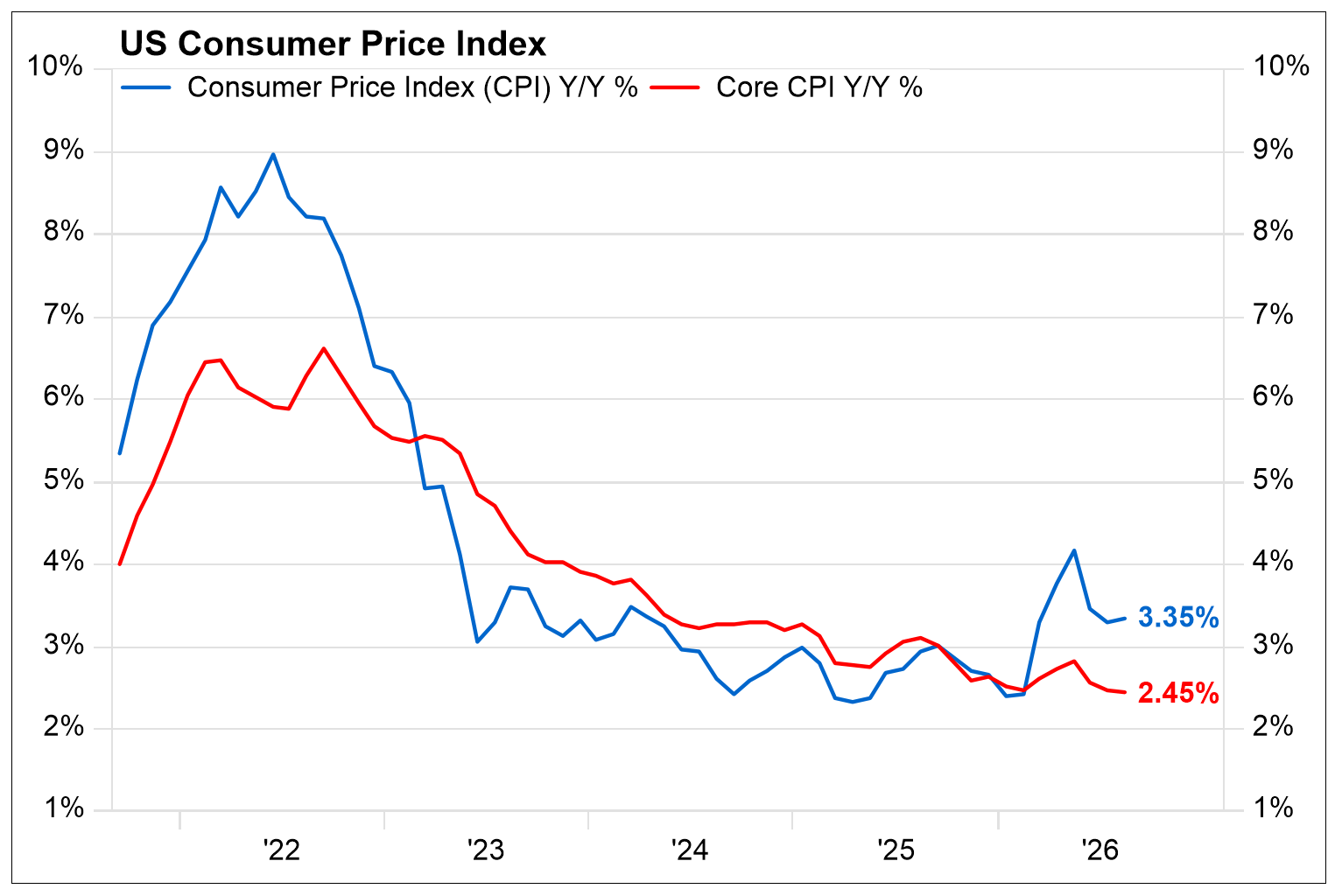
Source: FactSet
Dovish commentators pointed out that raising interest rates does little to address the root cause of this specific inflation bounce and risks slowing the economy towards stagflation. When asked about this, Warsh acknowledged that the Fed cannot affect the prices of individual goods such as crude oil, “but what we can do, and will do, is ensure that any change in relative prices don’t broaden out, don’t have second and third order effects in the economy.” Warsh also noted that the decision comes at a time when the American economy appears to be strengthening, citing improving metrics in hiring, private-sector earnings, and business capital investment. Given the typical 12–18 month lag before monetary policy is felt in the economy, tightening likely poses little immediate threat to these trends.
The Dot Plot
The Fed also released its Summary of Economic Projections, which includes each participant’s forecasts for inflation, employment, growth, and the Fed Funds Rate. Chair Warsh did not participate in the dot plot – same as in June. For equity investors, the key takeaway is that the Fed does not expect an aggressive hiking cycle like 2022's: the median forecast sees one more hike before year-end, a hold through 2027, and a cut in each of 2028 and 2029.
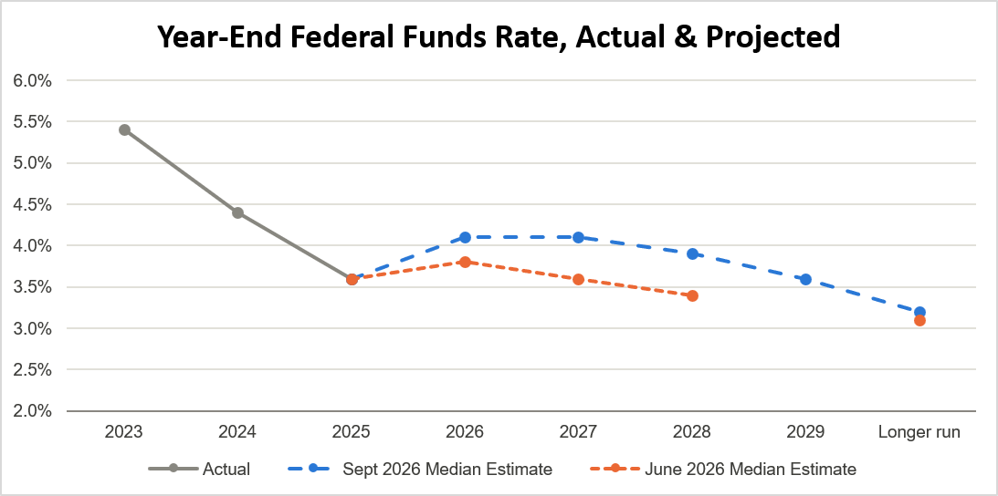
Source: Federal Reserve Summary of Economic Projections, 9/16/2026
What Does This Mean for Equities?
All else equal, higher rates are a headwind for equities, raising companies' cost of capital and compressing valuations, but history shows rate hikes alone are rarely enough to derail a bull market.
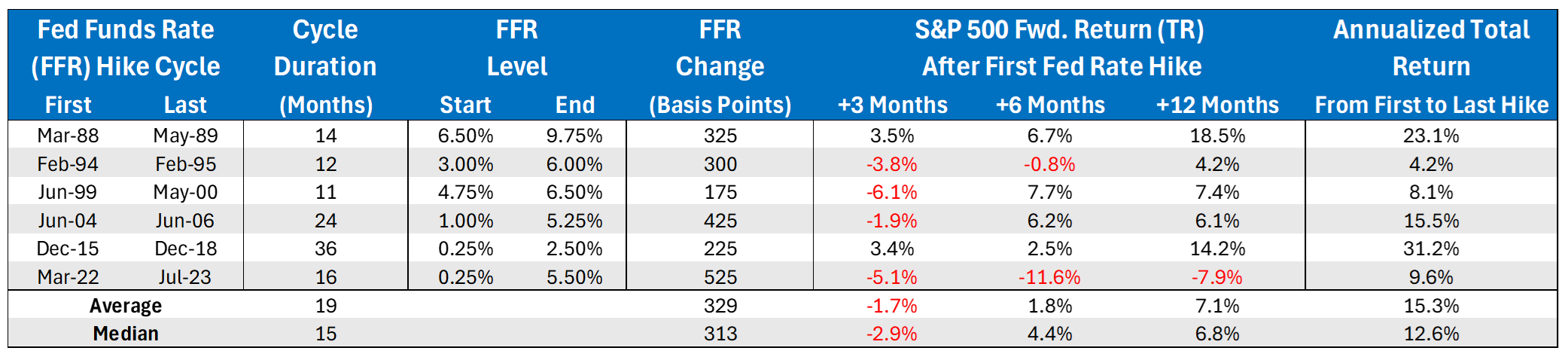
Source: FactSet
Equities have generally been able to advance through tightening, and the episodes that did real damage shared a profile this one does not. In those cycles, the Fed raised rates by several hundred basis points over a compressed window, typically chasing surging inflation, and often into valuations already stretched to a breaking point. What the FOMC has projected here is roughly 50 basis points of total tightening followed by a long hold, and the Fed is moving with core inflation at a five-year low rather than chasing it. For equities, why and how aggressively the Fed tightens matters more than the fact that it is tightening: a brake pump is not a restrictive hiking cycle.
This leg of the bull market is being driven above all by exceptional earnings growth, with Q2 earnings up about 52% year-over-year, the best quarter since 2021. AI-related capex from the hyperscalers and a resilient consumer are core drivers behind this growth, and we don’t believe either is too exposed to light interest rate risk. While we have spoken recently about increasing debt issuance by the hyperscalers, the expected returns on these capex projects are likely high enough not to deter near-term spending in the face of slightly higher rates, and markets expect free cash flow to recover by 2028.
Pertaining to the consumer, housing, autos, and consumer credit can be somewhat interest rate sensitive, but the bulk of consumer spending is dependent on employment and real wages, both of which remain steady. A slow, shallow hiking cycle is unlikely to derail either.
Our View
We remain cautiously optimistic on US risk assets. The Fed has told us it intends to move modestly and then hold, it is acting against a backdrop of strengthening labor and capital spending data, core inflation is at its lowest level in over five years, and earnings projections remain robust.
The case for caution is not the rate hike itself but what could force the Fed’s hand beyond what it has projected. If the energy shock broadens into other goods and services, future dot plots could be revised upwards. Absent that, we do not see this move as a threat to the economy or the current bull market.