





















Key takeaways:
- Cash may solve a short-term problem, not a longer-term one. It offers stability and liquidity, but longer term, investors have historically given up meaningful return and real purchasing-power growth relative to high-quality bonds.
- Recent experience with cash-like investments can be misleading. Strong cash yields and the severe 2022 bond selloff may make cash equivalents, such as money market funds, look attractive today. But recency bias can obscure a much longer history in which bonds generally outperformed cash as holding periods lengthened.
- Bonds serve an important portfolio role beyond income, in our view. High-quality bonds can provide diversification when a stock market downturn is driven by slowing growth or financial stress, even though inflation shocks—such as 2022—can temporarily undermine that relationship.
How cash seduces
Cash has always been where investors go to duck financial market risk, and over the past few years they have been well compensated for doing just that. Cash has another draw. After more than a decade in which short-term interest rates spent much of their time near zero, cash equivalents like Treasury bills and money market funds again began offering yields that felt enticing. For investors who have just lived through the worst bond market in decades, the combination of a healthy level of income and virtually no price volatility is understandably appealing.
The rise in interest rates that began in 2020 inflicted unusually large losses on fixed-income portfolios, undermining the capital preservation expectation held by many investors. The Bloomberg U.S. Aggregate Bond Index peaked in August 2020 and, even six years later, the damage from that bear market has not been fully recovered. Cash, meanwhile, offered rising income without the uncomfortable volatility.
There is nothing unreasonable about preferring a safe investment harbor, particularly for funds that may be needed soon.
However, the risks associated with cash tend to reveal themselves slowly. This risk won’t reveal itself as an alarming drawdown on a statement or day-to-day volatility.
Instead, the cost shows up gradually through sacrificed return and declining income when short-term rates fall. Just as importantly, there is the loss of some of the diversification potential that high-quality bonds can provide when the economy weakens.
The price of safety
The historical difference between cash-like investments and bonds is easy to underestimate because it has typically amounted to a modest premium on an annual basis. Long term, however, that differential can have a large effect.
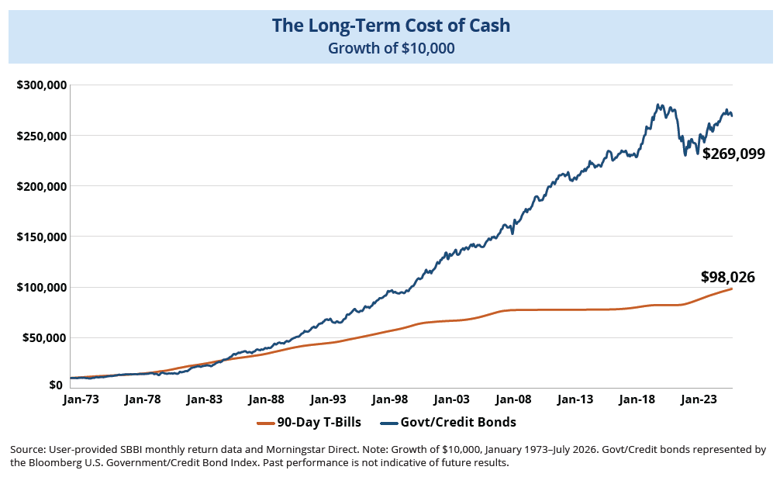
Let’s use the longest common history in market index data, from January 1973 through July 2026. 90-day Treasury bills, which we can use as a proxy for cash equivalents, returned 4.35% a year on an annualized basis. Meanwhile, the Bloomberg U.S. Government/Credit Bond Index, which we can use as a proxy for investment-grade bonds, returned 6.34%. A difference of 1.99 percentage points per year may seem unremarkable, particularly when compared with the volatility investors occasionally endure in bonds, but compounding will add up meaningfully over time.
Inflation’s eroding power
A hypothetical $10,000 invested in Treasury bills at the beginning of 1973 would have grown to approximately $98,000 by July 2026. The same investment in high-quality U.S. government and corporate bonds would have grown to roughly $269,000.
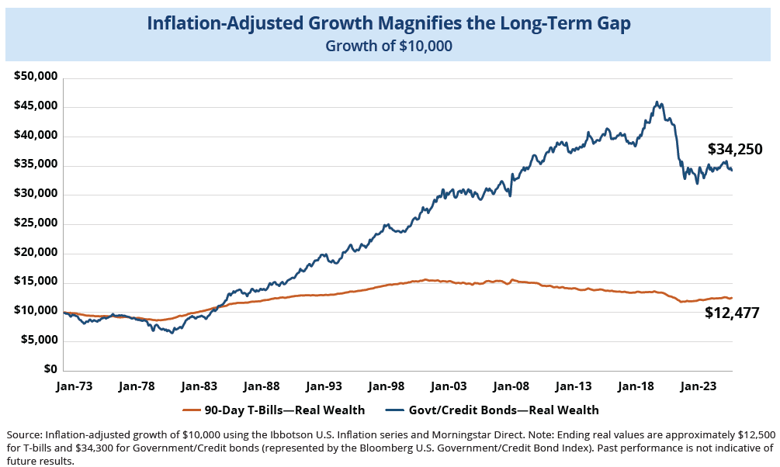
Inflation magnifies the performance gap between cash-like investments and bonds.
Over this long-term period, T-bills earned an annualized real return of approximately 0.4%, while investment grade bonds returned about 2.3%. Cash-like investments may have preserved purchasing power, but bonds did that and provided more real growth because investors were being compensated for accepting interest-rate and credit risk.
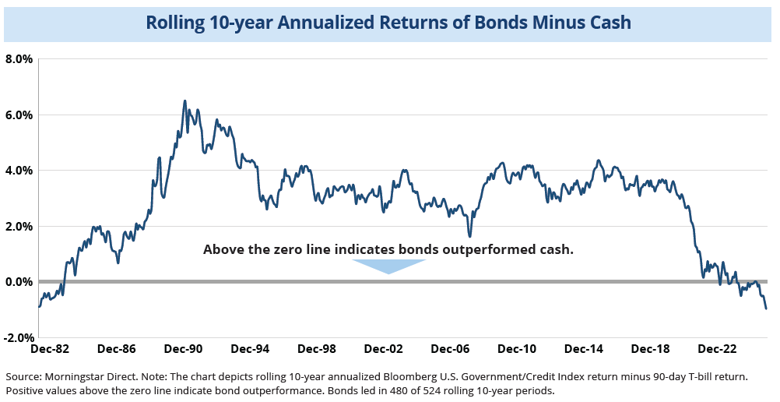
That return premium is not dependable over short periods. Bonds can trail cash for several years, as investors have been recently reminded. There will be environments in which avoiding interest-rate risk is clearly beneficial. However, as the holding period increases, the historical results become much more consistent.
Historically, investment grade bonds outperformed Treasury bills in about 92% of rolling 10-year periods and in every rolling 20-year period.
For an investor with a long horizon, the relevant cost of cash, therefore, extends beyond the yield available today. It includes the return that may be surrendered year after year by avoiding risks that have historically been rewarded over time.
The vagaries of cash
The second issue is reinvestment risk, which becomes particularly relevant when investors make long-term allocation decisions based on the current yield on a money market fund or Treasury bills.
Short-term securities mature quickly, so their yields continually reset to prevailing interest rates. That characteristic was extremely helpful as the Federal Reserve raised rates, since cash investors were able to reinvest at progressively higher yields without suffering the price declines experienced by longer-duration bondholders. Once rates begin moving in the opposite direction, the same mechanism becomes a disadvantage.
The recent rate-cutting cycle provides an example.
The trailing 12-month yield on 90-day Treasury bills reached approximately 5.3% in June 2024 and had fallen to about 3.7% by July 2026. An investor in cash did not lose principal as rates declined, but the income available on that principal fell materially.
A bond portfolio behaves differently because some portion of today’s yield is locked in for a longer period. If market interest rates subsequently decline, existing bonds may also appreciate as their coupons become more valuable relative to newly issued securities.
This is why the decision to remain in cash carries an implicit interest-rate view: the investor is repeatedly choosing to accept whatever short-term rate happens to be available in the future.
That may work well if rates remain high or rise further. It becomes less attractive if a weaker economy leads the Federal Reserve to cut rates, since the return on cash would likely decline at roughly the same time that falling yields could benefit longer-term bonds.
Bonds still can be a powerful diversifier
The difference between cash and bonds also matters when considering the role fixed income plays alongside equities. Cash provides stability during a stock-market selloff, which is valuable, but high-quality bonds have sometimes done more than simply hold their value.
During the Dot Com bust from September 2000 through September 2002, the S&P 500 lost about 45% while the Bloomberg U.S. Government/Credit Bond Index gained 24%. During the global financial crisis, using the November 2007 through February 2009 period, stocks declined roughly 51% while the Bloomberg U.S. Government/Credit Bond Index gained about 6%. Treasury bills also produced positive returns during both periods, but the gains were considerably smaller.
The reason is straightforward. When a crisis is driven by deteriorating growth, falling inflation or financial stress, interest rates often decline as investors seek safety and monetary policy becomes more accommodative. High-quality bonds can benefit from that decline in rates, giving investors a source of positive return at a time when their equity holdings are under pressure.
Those bond gains can also provide something useful for portfolio management: an appreciated asset that can be sold or rebalanced into stocks after a decline.
The exception is not the rule
There are exceptions that bear mentioning, including going back to the 1973-1974 period and most recently, 2022.
From January through September 2022, the S&P 500 declined about 24% and investment grade bonds fell approximately 15%, while Treasury bills posted a small gain. Inflation was the source of the shock; interest rates were rising rapidly, and the conditions that normally make bonds effective equity diversifiers were working in reverse.
Investors should remember 2022, but it should not become the expectation for every future market downturn.
A recession caused by weakening demand is different from an inflation shock, and a portfolio built for one particular type of crisis may prove poorly suited to the next one.
Final thoughts
A known human cognitive bias that places too much weight on recent events over long-term outcomes may be responsible for driving some investors out of bonds recently and into cash-like investments.
That is not to say cash is not without a portfolio role.
An allocation earmarked for near-term expenses or emergency reserves where principal stability is paramount generally belongs in cash or cash-like investments. A tactical position in cash may also be appropriate to manage risk in times of financial market stress.
For long-term portfolios, avoiding bonds altogether can create costs that are much harder to see on a monthly statement. Over the past half century, those costs have included a lower return, less growth after inflation and, during some of the worst equity markets, less diversification.
Cash can be a short-term allocation to manage expenses or for waiting out a passing financial market storm. History suggests that it has been a much less rewarding place for money that is waiting to grow.