





















Key Takeaways:
- Strong corporate earnings and broader market participation have supported the bull market’s strong equity returns from 2022 to 2026.
- The AI build out is a key growth catalyst going forward.
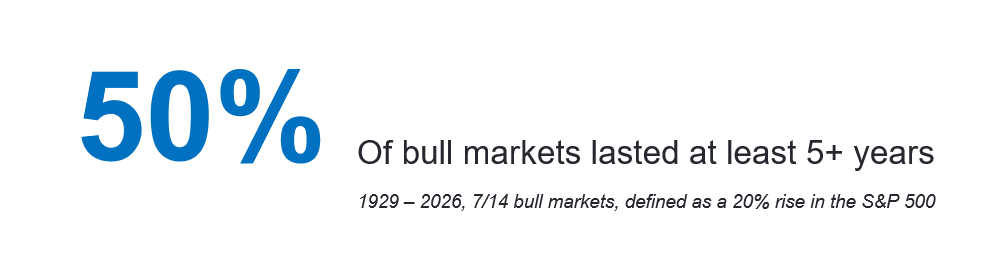
- 50% of bull markets make it to their 5th birthday.
Four years ago, the investment environment looked very different.
Inflation had surpassed 9% on an annual basis - its highest level in decades, the Federal Reserve was rapidly raising interest rates, and investor sentiment had deteriorated sharply. The S&P 500 ultimately reached its bear-market low on October 12th, 2022, establishing the starting point for the bull market investors are celebrating today.
Since then, markets have overcome a long list of concerns, including restrictive monetary policy, geopolitical conflict, recession forecasts, banking stress, supply chain disruptions, trade uncertainty, and questions about whether enthusiasm surrounding artificial intelligence had moved too far, too fast.
Yet the bull market has continued to advance. From its low in 2022, the S&P 500 has delivered nearly 130% since, on a total return basis. As it enters its fifth year, the more important question is not simply how far stocks have come, but whether the forces supporting the rally remain intact.
From Inflation Shock to Earnings Growth
The early phase of the bull market was driven in part by relief. Inflation began to moderate, recession expectations eased, and investors grew more confident that the Federal Reserve could eventually step away from its aggressive tightening campaign.
The market’s more recent gains, however, have increasingly been supported by corporate fundamentals. Earnings have expanded while valuation multiples have contracted, a combination that suggests profits, rather than simply rising investor optimism, have been doing more of the work.
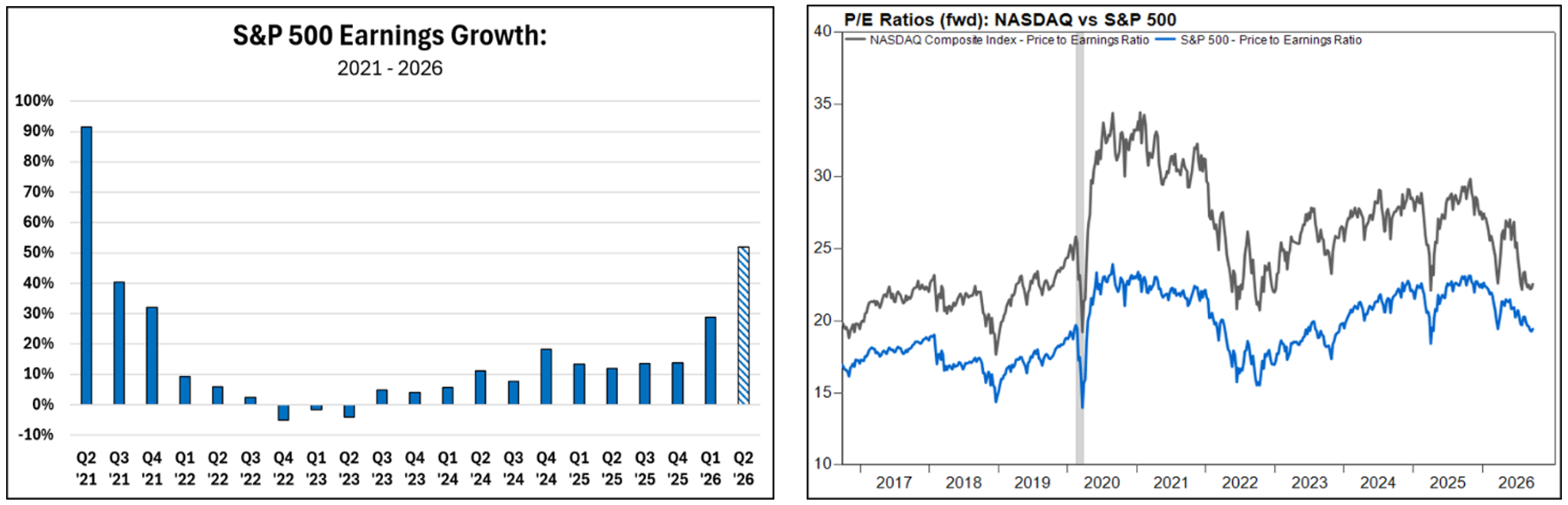
Source: FactSet
Gray bar represents a recession
Growth has also broadened beyond the largest technology companies, with improving earnings trends among smaller companies and attractive long-term growth expectations in emerging markets.
That broader participation matters. Healthy bull markets generally become more durable when gains are supported by multiple sectors, styles, and regions rather than a narrow collection of market leaders.
AI Remains an Important Economic Tailwind
Artificial intelligence has been one of the defining themes of this market cycle. The investment is not limited to software or semiconductor companies. It is driving spending on data centers, energy infrastructure, manufacturing, real estate, power generation, networking equipment, and other areas of the economy.
2026 has been a major year for AI-related capital expenditures.
This buildout could support economic growth, corporate revenue, and productivity. Guidance from “hyper-scalers” estimates that U.S. technology companies will spend approximately $750 billion on AI infrastructure in 2026, with spending potentially exceeding $1 trillion in 2027.1 U.S. labor productivity has also been accelerating since 2022, with output per hour rising 2.2% in 2025.
Those investments are substantial, and investors will eventually expect them to produce meaningful returns. For now, though, the AI capital-spending cycle remains an important source of demand throughout the economy.
Four Years Does Not Automatically Mean “Late Cycle”
A four-year-old bull market may sound mature, but age alone has historically been a poor reason to become bearish.
Since 1929, seven of the 14 identified S&P 500 bull markets lasted beyond five years.
Source: Factset, Yahoo Finance
Market peaks also tend to be associated with a collection of warning signs rather than a birthday. These can include extreme optimism, parabolic price gains, deteriorating earnings, widening credit spreads, narrowing market participation, excessive speculation, and markets becoming disconnected from their underlying fundamentals.
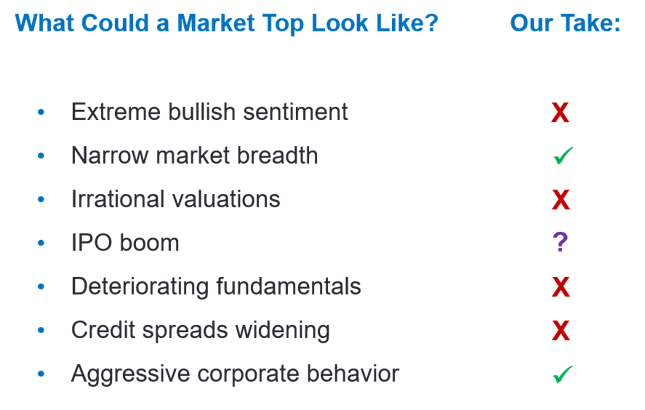
Some areas deserve attention. IPO activity has strengthened (at least in magnitude), valuations are elevated, and corporate behavior has become more aggressive; But most of the classic “market top” warning signs are currently absent. Fundamentals remain supportive, credit markets have not shown broad stress, and participation has extended into small-cap, value, and emerging-market equities.
The Risks Have Not Disappeared
A constructive outlook does not mean investors should expect a smooth ride.
Inflation remains a concern, particularly as energy costs, geopolitical tensions, government debt, and AI-related infrastructure spending place upward pressure on prices and bond yields. Higher borrowing costs could eventually weigh on small businesses, consumers, and the broader economy.
Other risks include an escalation of conflict with Iran, continued trade uncertainty, stress among lower-income consumers, cracks in the labor market, disappointment in the AI capital-spending cycle, and problems within private credit spilling into public markets.
Looking Ahead to Year Five
The foundation supporting the bull market remains constructive. Corporate balance sheets appear healthy, earnings growth has been strong, consumers continue to spend, AI investment is supporting capital expenditures, and small-cap strength suggests the market is not pricing in an imminent recession.
Valuations also leave less room for disappointment. That makes earnings delivery increasingly important and reinforces the need for diversification, disciplined portfolio construction, and realistic return expectations.
The bull market’s fourth birthday is therefore neither a reason for complacency nor a signal to abandon equities. It is a useful reminder that markets can continue rising despite persistent uncertainty when economic growth and corporate profits remain supportive.
The bull may be four years older, but the evidence suggests it may still have room to run.