





















Key Takeaways:
- The recent selloff has prompted some clients to reconsider how much equity risk they’re comfortable taking, even as their long-term goals remain the same.
- Diversification, active management, and hedged equity offer three ways to build resilience within an equity portfolio, each with its own costs and trade-offs.
- Advisors can use a client’s time horizon, income needs, and reaction to market declines to shape an equity allocation they can stick with.
It’s been a difficult few weeks for Wall Street, including the S&P 500’s 12th worst week since 1952 for the week ended November 20th, in which the index fell 8.6%. Technology (-12%) and US Growth (-11%) were especially ravaged as the AI theme came under intense pressure. Monday’s rebound provided some much-appreciated relief, but some clients may be realizing that they aren’t as comfortable with their equity portfolios as they thought they were.
When markets tumble, a client’s reaction can tell you a lot about whether their portfolio matches their composure. Advisors can add value by providing perspective and returning the conversation to purpose: conditions may have changed, but has the destination changed? If a client’s objectives, time horizon, and need for growth are the same as they were this summer, the answer usually isn’t to dramatically reduce equity exposure, but rather to build a more resilient equity portfolio.
Advisors have several levers they can pull within the equity allocation to keep clients invested and make the ride easier to stay on. Each one addresses a different risk, comes with different costs, and suits different clients. Finding the right balance can help align the portfolio with the investor’s goals and tolerance.
Matching the Tool to the Client
| Lever | What it may protect against | What it costs | Best-fit client |
|---|---|---|---|
Diversification (across style, size and geography) | Concentration risk. Helps when a selloff is led by one style or sector, or by a handful of mega-caps, as in this fall's AI-led pullback. | Very little. Low-cost, passive ETFs offer clients the ability to gain broad, diversified equity exposure with low barriers to entry and low management fees. | Nearly everyone. Especially useful for clients whose portfolios have drifted toward cap-weighted growth after years of mega-cap leadership. |
| Active management | Index-construction risk. Active managers can recognize when an index has become expensive or overexposed to a few risk factors and move to less crowded and less exposed areas of the market. | Higher fees and manager risk. Active strategies charge higher fees than their passive counterparts, increasing their hurdle rate for net returns. Hiring managers often requires more due diligence than index funds. | Many portfolios, allocated thoughtfully. Can complement passive by deploying in areas where active has an edge, or where diversification in management style benefits the portfolio. |
Hedged equity / downside mitigation (options overlays, buffered/defined-outcome strategies, tactical or trend-following) | Broad, correlated drawdowns. This covers the 2008-style declines where diversification within equities fails. It also helps with sequence-of-returns risk for clients who are withdrawing. | Higher fees and upside participation. The cost of consistent downside protection manifests in higher expense ratios and capped/lagging up capture. Communication and managing expectations are key when using these. | Clients near or in retirement, clients funding a known goal, or clients likely to sell at the bottom. For these clients, a smoother ride may help keep them invested. Knowing your client is how you add value. |
These levers aren’t mutually exclusive. Most portfolios layer them: diversify first, add active where it can add value, and hedge when a client’s situation or temperament calls for it.
Lever 1: Diversification Within Equities
While not the most exciting idea, diversification can be the simplest, lowest-cost, and most broadly suitable line of defense for equity portfolios. If the goal is resilience, that means there cannot be a single point of failure. One theme, style, or shock shouldn’t be able to sink the portfolio. By spreading a portfolio across styles, sizes, regions, and risk exposures, you can cushion concentrated drawdowns at very little cost.
2026 has been a case study in the value of diversification within equities. Small and mid-caps have outperformed large caps, international equities led US markets for most of the year before recently falling back to roughly even, and sector performance has been led by energy, consumer staples, and healthcare. As of 10/31, the Russell 1000 Value Index was outperforming the Russell 1000 Growth Index by 31 percentage points on a 12 month basis – the widest such dispersion since 2001.
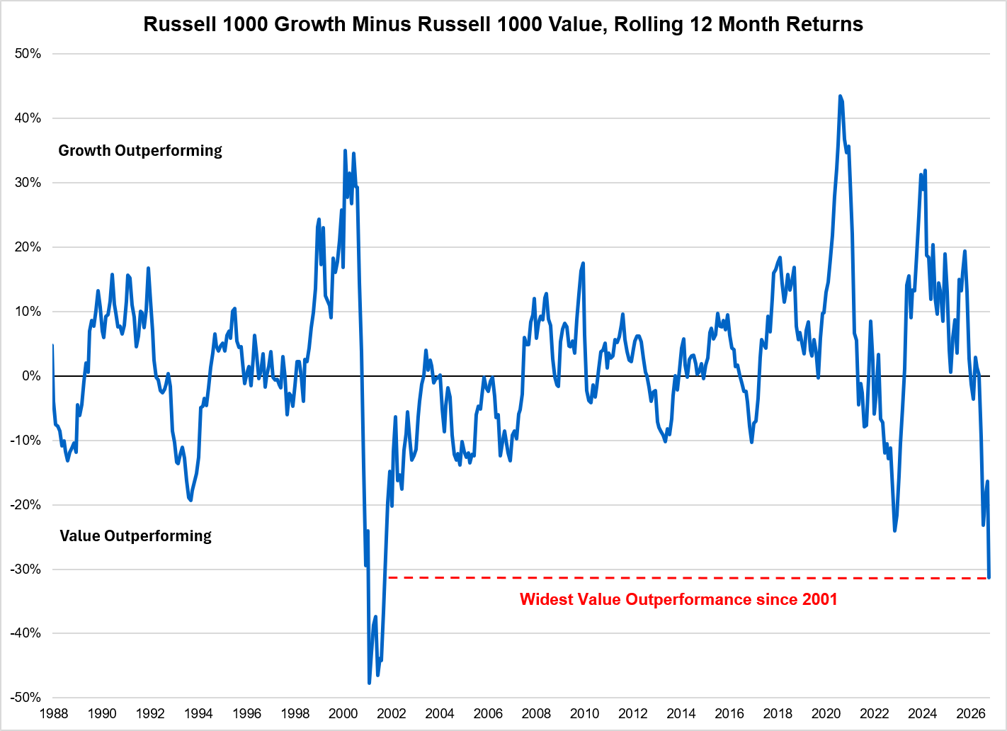
Source: Morningstar Direct
Market relationships tend to move in long-term cycles of outperformance, and consistently predicting the path and timing of those cycles is incredibly difficult. Making diversification the starting point sets investors up to navigate those cycles with discipline.
Lever 2: Active Management
Active management contributes to portfolio resilience by adding adaptability, allowing the portfolio to adjust to changing conditions. Passive, cap-weighted indexes are agnostic to becoming concentrated, overvalued, or overexposed to certain risk factors. Active managers can make different choices: trimming crowded positions, rotating toward less-loved areas of the market, and favoring companies well-positioned for the current environment.
That flexibility and skill tend to matter most when markets get choppy and dispersion is high, as it has been this year. These environments are why we hire managers to make difficult real-time calls within a disciplined process.
While suitability varies by client, we believe active management belongs in many portfolios when it’s sized and allocated deliberately, often alongside low-cost passive exposure rather than in place of it. Passive holdings provide efficient, broad market exposure, while active managers add flexibility and value where it can matter most. Still, results vary widely by manager, and fees and stretches of underperformance are real costs, so manager selection matters. We lean on the experience and insight of Orion's Due Diligence Team, which researches and monitors active managers on our advisors' behalf so they can spend more time with their clients.
Lever 3: Hedged Equity/Downside Mitigation for the Right Clients
The first two levers can work best in rotational markets like this year's, when one area's losses are another's gains. Diversification makes sure you hold both, and active managers try to tilt toward the winners. In rare cases, however, almost everything loses. In a crisis like 2008, investors aren't selling one thing to buy another. They're fleeing to high-quality bonds or cash. Correlations across stocks spike, and broad losses can follow.
Hedged equity and other downside-mitigation strategies are built for those moments, and they can add the last layer of resilience: keeping losses survivable, both financially and emotionally. They come in several forms, including options-based overlays, buffered or defined-outcome strategies, and some tactical or trend-following approaches. Most share a common trade-off: they give up some upside in exchange for shallower drawdowns, and therefore can lag meaningfully in strong rallies.
For the right client, that trade-off can be worth making. A retiree drawing income faces sequence-of-returns risk that a younger saver doesn't. And a client who would otherwise panic-sell is better served by a strategy they'll stick with than by one with higher expected returns that they abandon. The best hedge is often the one that keeps an investor in the game.
Takeaways
Markets will always find a way to test conviction. This fall has been a reminder of that, but it doesn’t have to mean stepping away from equities.
Each lever is intended to play a role: diversification guards against a single point of failure, active management adds adaptability, and downside mitigation keeps losses survivable for the right clients. Used together and matched to the client, they can help investors stay the course.
Staying invested requires knowing the client and preparing the portfolio for a range of outcomes. If the destination hasn’t changed, the goal is a portfolio resilient enough to get there.