




















Most advisory firm leaders aren't making decisions in the dark. They have reports. They have dashboards. They have data teams pulling numbers on demand.
And yet, when it's time to make the call on a strategic hire, a new market push, or a portfolio concentration concern, the conversation often stalls. The information exists somewhere in the system, but it's not decision-ready. It's scattered across platforms, frozen in yesterday's snapshot, or prepared for compliance rather than leadership.
This is the executive blind spot: the gap between having data and having insight.
At scale, the issue usually is not a lack of data. It’s that the data lives in separate systems, and there is no unified data layer to normalize it, connect it, and make it usable across the firm. Without that foundation, “insight” becomes a manual project instead of a built-in capability.
For firms managing hundreds of millions or billions in assets, that gap can show up as delayed action, second-guessed strategy, and meetings that drift toward validating numbers instead of deciding what to do next.
The Illusion of Visibility at Large Firms
Scale brings sophistication. More advisors, more offices, more client segments, and more technology. Many firms respond by building reporting infrastructure: performance dashboards, compliance summaries, and AUM breakdowns.
Those outputs are useful, but they don't automatically create clarity.
Reports tell you what happened. Dashboards give you a point-in-time view. Leadership still needs something different: decision-ready insight that connects the full picture and surfaces what matters before it becomes urgent.
The Executive Reality Check
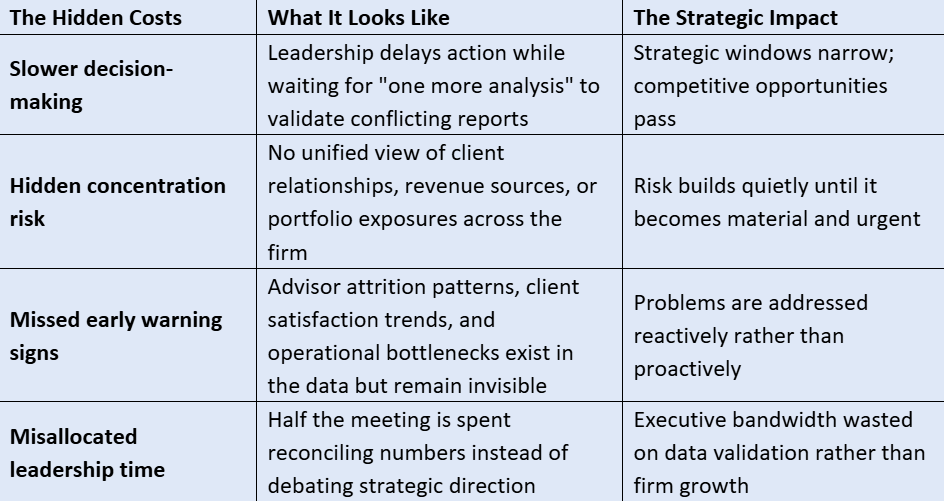
Ask yourself: In your last strategic planning meeting, how much time did your team spend validating numbers versus debating what to do about them?
If the answer is "most of it," you're experiencing the insight gap.
Understanding client concentration by advisor, tracking portfolio drift across models, or analyzing revenue trending against operational capacity—these aren't single-system questions. When the answers require manual assembly across multiple platforms, executives spend more time gathering information than acting on it.